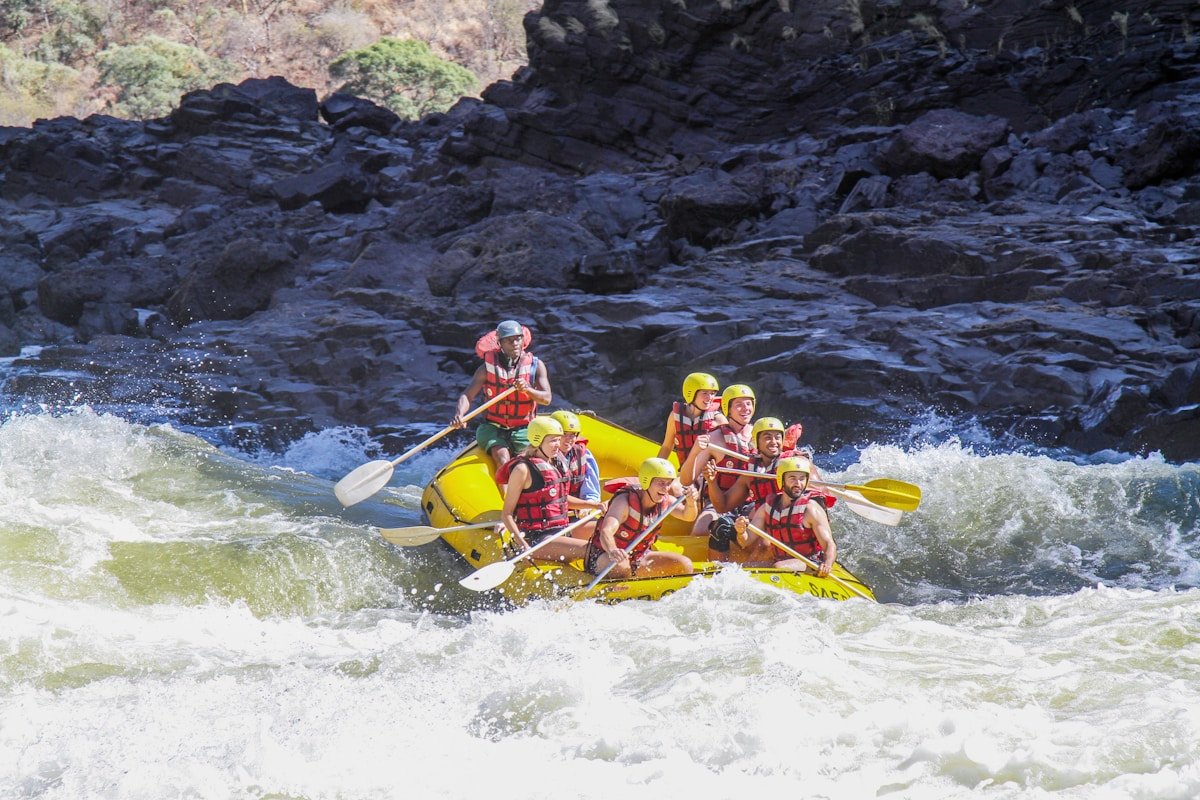
The Zambezi River drops over 100 metres into a narrow basalt gorge immediately below Victoria Falls, then thunders through 24 named rapids over roughly 25 kilometres before opening into a wider valley. This stretch is consistently ranked among the world’s top five commercial white-water rafting runs - partly for the difficulty of the rapids, partly for the sheer drama of being enclosed by 70-metre walls of black rock, and partly because you begin the day standing next to one of the world’s largest waterfalls.
The Gorge at a Glance
The Batoka Gorge cuts deep into the basalt plateau on both sides of the Zimbabwe-Zambia border. Once you descend the steep path from the Victoria Falls viewpoints to the Boiling Pot at the river’s edge, you enter a different world entirely. The thundering curtain of the falls is audible but invisible from down here. What you see instead are sheer walls, surging green water, and a series of churning hydraulics that have been attracting rafters since the 1980s.
The full commercial run starts at Rapid 1 (The Boiling Pot, immediately below the falls) and exits around Rapid 23 or 25, depending on your operator. Most half-day trips cover approximately the first ten rapids and return via a dramatic hike up the gorge wall. Full-day trips continue further downstream, finishing with a cable car or steep scramble out on the Zambian side.
The Rapids You Should Know
Rapid 9 - Commercial Suicide (Grade 5): A long, powerful rapid with a punishing hydraulic at its base. The name originated in the early commercial rafting days when operators were unsure whether running it was commercially viable. It is. Most groups flip here at least once.
Rapid 10 - The Mother (Grade 4+): A complex series of waves following closely after Commercial Suicide. Tired paddlers come unstuck here regularly.
Rapid 11 - The Muncher (Grade 5): Arguably the gorge’s most feared feature - a sucking hole that can hold a raft for several seconds. Guides sometimes choose to portage here depending on water levels and group ability.
Rapid 18 - Oblivion (Grade 5): A long, multi-stage rapid on the lower half of the run. Full-day trip participants encounter this mid-afternoon when paddling arms are already well-used.
Choosing Your Operator
Several established operators run the gorge from the Zimbabwe side. All use professional guides trained to international rescue standards and supply helmets, life jackets, and paddles.
SafPar (Safari Par Excellence) is the largest operator on the Zimbabwe side, running both half-day and full-day trips year-round. Approximately USD 120 for half day, USD 175 for full day as of 2026. Office located on the main road in Victoria Falls town. You can also compare rafting packages and other gorge experiences through Victoria Falls waterfall activities on GetYourGuide before booking.
Shearwater Adventures has been running the gorge for over three decades and offers a polished operation with strong safety systems. Comparable pricing to SafPar. They also bundle rafting with bungee jumping or the gorge swing for combo savings.
Wild Horizons focuses on smaller group sizes and offers a more personalised experience. Prices are slightly higher - approximately USD 140 for half day - but the guide-to-rafter ratio is better.
All three operators depart from Victoria Falls town with hotel transfers included. Book directly at their offices (located along Park Way and Livingstone Way in Victoria Falls) or through your hotel activities desk. Booking 24–48 hours ahead is sufficient outside peak season (July–August), but earlier in July and August when the gorge is busy.
What to Bring
- Swimwear under a rash vest or light t-shirt - you will be wet for the entire trip
- Secure sandals or old trainers that can get wet (flip-flops are not suitable)
- Sunscreen applied before you arrive - you won’t be able to reapply on the water
- A small dry bag or waterproof camera case if you want to bring a phone
- A change of clothes and a light towel for after the exit hike
All safety equipment (helmet, life jacket, splash jacket on cold days) is provided. Operators supply a guide per raft, typically one guide per 6–8 paddlers.
The Season Question
The Zambezi’s flow varies enormously by season, which affects both the number of accessible rapids and the difficulty of those that remain open.
June to August is optimal: water levels are falling after the rainy season, nearly all 24 rapids are accessible, and temperatures in the gorge are tolerable (25–30°C). This is peak tourist season, so book ahead.
September to November offers lower water levels, which actually makes certain rapids more technical - exposed rocks create additional features. Temperatures at the bottom of the gorge can exceed 40°C in October and November, so bring extra hydration.
December to February sees rising waters as the rains build. Some lower-gorge rapids partially flood out. January can still be excellent for upper-gorge rafting. February to April is when water levels peak - the gorge is sometimes completely closed in March and April.
Getting Down to the River
All operators include transportation from your hotel to the gorge entrance point. The hike down from the plateau to the Boiling Pot takes approximately 20–30 minutes on a rocky zigzag trail. It is steep - you will climb this same path in reverse at the end of a half-day trip, legs and arms already tired. The full-day trip uses a cable car or vehicle exit on the Zambian side, which is less demanding physically.
Allow a full morning or full day depending on your trip length. Transfers typically depart hotels between 07:30 and 08:30.
After the Gorge
The climb out is followed by a full debrief and usually a meal or drinks at a riverside lodge. Most operators return you to your hotel by early afternoon for a half-day trip or around 17:00 for the full day. The rafting is physical enough that a quiet evening and an early night typically follows - which works well if you have another activity booked the next morning.
Victoria Falls has no shortage of adjacent activities: the bungee jump and gorge swing are operated from the bridge 10 minutes’ walk away, and sunset cruises on the Upper Zambezi provide a gentle contrast to the gorge chaos. Many visitors pair a morning rafting trip with an afternoon sunset cruise on consecutive days.
Practical Notes
- Book at least 24–48 hours ahead in peak season (July–August)
- The minimum age is typically 15; under-18s require parental consent
- Leave valuables at your hotel - phones go in dry bags or stay behind
- Wear high-factor waterproof sunscreen - reflection off the water intensifies UV exposure
- Drink plenty of water before and during - the gorge is hot and physically demanding
- The exit hike involves scrambling in wet gear with tired legs; plan ahead
- Arrange travel insurance for Zimbabwe that explicitly covers white-water activities - confirm the policy includes Grade 5 rapids before you arrive
- For accommodation in Victoria Falls, search hotels on Booking.com to find lodges and guesthouses close to the gorge entrance