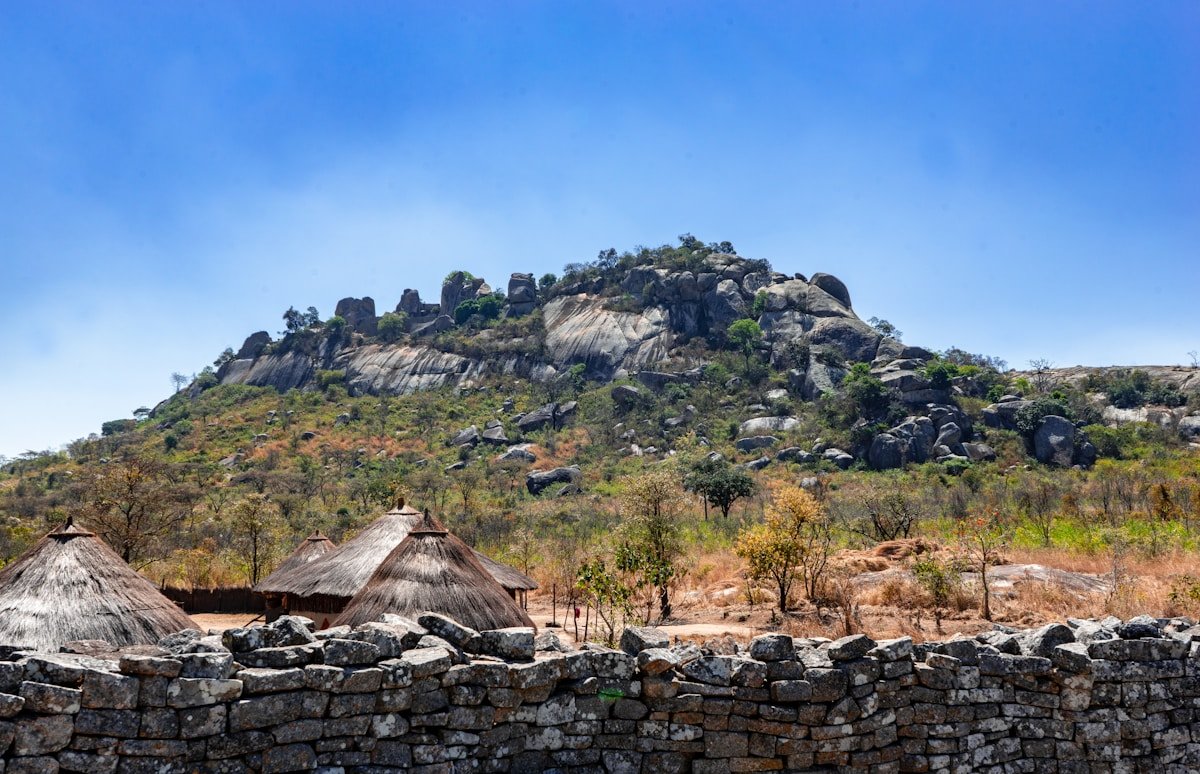
Great Zimbabwe stands as the most significant archaeological site in sub-Saharan Africa and the structure from which modern Zimbabwe takes its name. Built by the Shona-speaking ancestors of Zimbabwe’s largest ethnic group, it was the capital of a medieval trading kingdom that controlled gold and ivory routes between the Zimbabwe Plateau and the Indian Ocean coast.
The name “Zimbabwe” derives from the Shona dzimba dze mabwe - “houses of stone” - and the ruins are precisely that: stone enclosures, towers, and walls built without mortar, without metal tools, and without European influence of any kind. They are entirely indigenous.
The Kingdom of Zimbabwe
At its height between roughly 1220 and 1450 CE, the Kingdom of Zimbabwe was the dominant political and economic power on the Zimbabwe Plateau. Great Zimbabwe served as its capital and royal court - a city of between 10,000 and 18,000 inhabitants at its peak, according to most archaeological estimates.
The kingdom grew wealthy on trade. Gold from the plateau was carried east to Sofala (on the Mozambique coast), where Arab and later Swahili merchants shipped it across the Indian Ocean to India, Arabia, and China. Glass beads from India, porcelain from China, and copper from the Congo have all been found in the ruins - confirming Great Zimbabwe’s position in a global trade network.
The ruling elite, whose exact ethnic and political identity remains debated by historians, lived within the stone enclosures while a larger population occupied surrounding daub-and-thatch settlements. The stone walls appear to have been symbols of royal prestige rather than defensive structures - there are no loopholes, no towers for archers, no moat.
The site was abandoned around 1420–1450 CE, probably due to a combination of environmental degradation (the population had likely overstretched the capacity of local soils and firewood), a shift in trade routes, and political fragmentation. Successor states - the Mutapa kingdom in the north and the Torwa state in the southwest (whose capital was Khami, near Bulawayo) - continued the tradition of stone-building but never reached Great Zimbabwe’s scale.
The Three Main Areas
The Hill Complex
This is the oldest part of the site, built on a natural granite hill above the valley. It dates from approximately 900–1300 CE and was likely the original religious and royal centre. The climb is steep (about 15–20 minutes) but manageable for most visitors.
At the top, the walls curve around natural boulder formations with extraordinary precision - the builders incorporated the granite outcrops into their walls rather than moving them, creating organic enclosures that follow the rock’s natural form. The views from the top across the valley ruins and surrounding bushveld are outstanding.
Look for the soapstone bird carvings originally found here - replicas are displayed in situ; the originals are in the site museum and the Natural History Museum in Bulawayo. The Zimbabwe Bird has become the national symbol of Zimbabwe, appearing on the flag, coins, and official documents.
The Great Enclosure
The most imposing structure at Great Zimbabwe and the most photographed, the Great Enclosure is an elliptical outer wall approximately 250 metres in circumference, 10 metres high, and 5 metres thick at the base. It was built with an estimated 900,000 granite blocks, each shaped without metal tools - a staggering feat of human labour.
Inside the outer wall, a narrow passage runs between the outer and inner walls - a constriction designed to slow the movement of large groups of people and potentially used for initiation ceremonies. At the southern end of the passage stands the Conical Tower: a solid, circular stone structure about 9 metres tall with no doorway and no internal chamber. Its exact purpose remains unknown; theories include granary, royal symbol, and phallus.
The Great Enclosure is believed to have been the residence of the king’s principal wife.
The Valley Ruins
Below the hill and surrounding the Great Enclosure, the Valley Ruins comprise a series of smaller stone enclosures where the elite court and extended royal household lived. These are less dramatic in scale but contain interesting detail - grinding stones, drainage channels built into the walls, and evidence of metal-working activities.
The Site Museum
A small but well-curated museum at the site entrance covers the history, archaeology, and cultural context of Great Zimbabwe. Key exhibits include:
- Replica Zimbabwe Birds (soapstone carved birds from the Hill Complex)
- Chinese porcelain excavated from the site
- Glass beads from India
- Examples of early Shona metalwork
The museum is included in the site entry fee and takes about 30–45 minutes to visit properly.
Guided Tours
Guides are available at the site entrance for approximately USD 10–15 additional per group as of 2026. We strongly recommend taking one - the stone enclosures look impressive but lack labels, and understanding the social function of each area dramatically enriches the visit. The guides at Great Zimbabwe are generally knowledgeable and proud of the site’s history. You can also browse GetYourGuide’s Great Zimbabwe tours for guided visits with historical commentary booked before you arrive.
Some guides at the site speak French, Portuguese, and German in addition to English and Shona; ask at the ticket office.
For guided tour options and practical booking details, browse Great Zimbabwe tours on GetYourGuide.
Where to Stay
Great Zimbabwe Hotel (previously Lodges of the Great Zimbabwe) sits immediately adjacent to the ruins, within the UNESCO buffer zone. Comfortable rooms, a pool, and the proximity to the site make it the obvious base. From approximately USD 80–130 per night as of 2026.
Masvingo town (27km) offers more budget options including guesthouses from approximately USD 25–40 per night. Clipsham Guesthouse and Regency Hotel are the most consistently reviewed. Browse current availability in the area using search hotels in Masvingo on Booking.com.
Great Zimbabwe National Park Campsite has basic camping facilities adjacent to the ruins, popular with self-drive travellers.
Combining Great Zimbabwe with Other Sites
Great Zimbabwe pairs naturally with:
- Masvingo city (27km) - Zimbabwe’s oldest colonial town, with Fort Victoria’s historic centre and Kyle Recreation Area for boat trips.
- Gonarezhou National Park (3.5–4 hours south) - Zimbabwe’s second-largest park, excellent wildlife and very few tourists.
- Matobo Hills (Bulawayo, 2.5–3 hours west) - another UNESCO site with more ancient history at Khami Ruins.
Travel insurance is recommended for any Zimbabwe trip - arrange cover via EKTA before departure. See our Masvingo guide for full city details and our Khami Ruins guide for the related successor kingdom site near Bulawayo.
Great Zimbabwe is not just a ruin - it is the physical evidence that one of Africa’s most sophisticated medieval civilisations existed here, built by Shona people, sustained by global trade, and long predating any European presence on the continent. The site was systematically dismissed or misattributed by colonial-era commentators who could not accept an African origin; that history of denial makes visiting and understanding it all the more important.