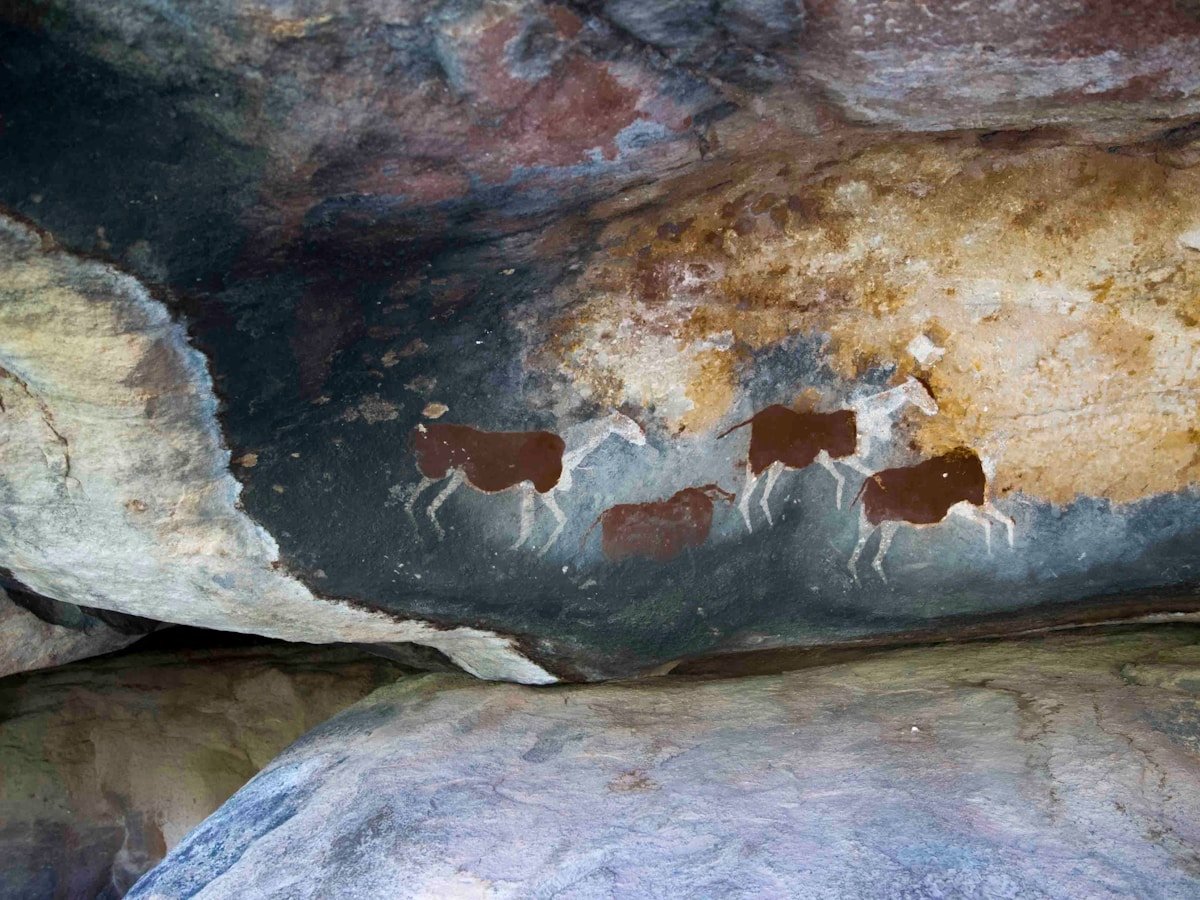
The Matobo Hills are a landscape of extraordinary geological drama - a sea of granite boulders and rounded hills called kopjes extending south from Bulawayo across hundreds of square kilometres. They are home to Zimbabwe’s densest population of leopard, Africa’s largest concentration of Verreaux’s eagle, and some of the most remarkable prehistoric art on the continent.
The San people - hunter-gatherers who lived across southern Africa for tens of thousands of years before Bantu-speaking farmers arrived - painted on these granite surfaces for millennia. Their art is not decoration. It is spiritual narrative: the paintings record trance experiences, hunting rituals, encounters with rain animals, and the beliefs of a people who lived in profound relationship with their landscape. Visiting the sites requires understanding that you are reading a sacred text.
The San Artists
The San (also called Bushmen) were the original inhabitants of southern Africa. They were hunter-gatherers whose rock art tradition appears across southern Africa from the Cape to the Limpopo Valley - but the Matobo Hills hold some of the oldest and finest concentrations anywhere.
San society was organised around small mobile bands. Specialist shamans (healers) entered trance states - induced through rhythmic dance and hyperventilation - during which they experienced spiritual visions. The rock art is believed to record these visions: the sensation of transformation into an animal, the experience of entering the world beneath the water’s surface, encounters with supernatural beings and healing powers.
The eland - southern Africa’s largest antelope - appears repeatedly in San rock art across the continent. Eland were regarded as the animal most saturated with supernatural power (potency) and closely associated with rain, death, and healing. Understanding the eland’s spiritual significance makes rock art panels that might otherwise seem like simple hunting records reveal themselves as complex religious statements.
The San were displaced and killed by Nguni and Bantu-speaking groups moving south from the 3rd to 10th centuries CE, and by European settlers from the 17th century. Their descendants in Zimbabwe today are small communities in Hwange and the Gwaai-Tsholotsho area.
Key Rock Art Sites
Nswatugi Cave
Nswatugi is the most visited and arguably finest rock art site in the Matobo Hills. The cave is a granite overhang sheltering a long panel of paintings in exceptionally good condition for their age.
The dominant image at Nswatugi is a giraffe painted in reddish ochre, about 1.5 metres tall - one of the largest and best-preserved animal images in Zimbabwe’s rock art. Below and around it, smaller figures of kudu, eland, and human shapes (some with elongated forms suggesting trance transformation) fill the granite surface.
A small information panel near the entrance provides context. Rangers are available for guided interpretation (tip approximately USD 5–10 per group).
Location: Approximately 45km south of Bulawayo, signed from the main Matobo road. Entry to Matobo National Park includes access (approximately USD 15 per person as of 2026; confirm current fees at the gate).
White Rhino Shelter
This site takes its name from a large white rhinoceros painted in white ochre - a rare depiction in the Matobo corpus. The white rhino panel is notable both for its artistic quality and its historical documentation: it shows that white rhino were once common in the Matobo Hills. (White rhino are now protected in the Matobo National Park’s IPZ, following near-local extinction.)
The White Rhino Shelter is one of the more accessible sites, reachable on a short walk from the main road. The paintings include animal figures and abstract grid patterns that scholars interpret as representing the membrane between the physical and spiritual worlds.
Bambata Cave
Bambata Cave in the southeastern part of the Matobo Hills is one of the oldest known archaeological sites in Zimbabwe. Excavations in the late 19th and early 20th centuries revealed stone tools associated with Middle Stone Age occupation dating back over 50,000 years. The cave is named for the Bambata pottery style - a distinctive ceramic tradition - found in layers dating to approximately 2,000 years ago.
The rock art here is extensive though in more mixed condition than Nswatugi. The painted figures include human forms, eland, and abstract symbols on multiple surfaces. It requires a guide to navigate the site properly.
Silozwane Cave
One of the larger painted shelters in the Matobo Hills, Silozwane contains over 100 individual images on a long granite overhang. Particularly notable is a panel showing a line of human figures, some with animal heads or animal features, consistent with San depictions of trance transformation.
Silozwane requires a longer walk (about 3km round trip from the parking area) and is best visited with a guide.
Other Sites
The Matobo Hills contain more than 3,000 recorded rock art sites - one of the highest concentrations in the world. Many are on private land or community conservancies and are accessible only with specialist guides. The Matobo Hills Rock Art Safari run by several Bulawayo operators covers multiple sites in a day with expert San art interpretation.
Visiting the Matobo Hills
Getting there: 35km south of Bulawayo on the Matobo road. The drive takes about 45 minutes. Self-drivers with a high-clearance vehicle can reach the main sites independently. Budget travellers can take a commuter bus to Matobo village and hire a local guide on-site, though this arrangement takes more time.
Park entry: Matobo National Park charges approximately USD 15 per adult international visitor per day as of 2026. Vehicle entry is approximately USD 5. Fees cover access to both the wildlife areas and the rock art sites. Pay at the main gate.
Guided tours: We strongly recommend hiring a guide for the rock art. The context transforms the visit - without it, you see ochre marks on granite. With it, you begin to read a spiritual record left by people who understood this landscape with a depth that took thousands of years to accumulate.
Bulawayo operators including Safari Par Excellence, UTC Zimbabwe, and several smaller guides offer half and full-day Matobo rock art trips from approximately USD 80–150 per person as of 2026. You can also browse Matobo Hills tours on GetYourGuide for guided excursions with specialist rock art interpretation.
Best time: Year-round, but the cool dry season (May–August) is most comfortable for walking between sites. Mornings offer better light for photography of the paintings. Avoid midday in October–November when granite rocks become extremely hot.
Key rules:
- Do not touch the paintings under any circumstances - oil from human hands accelerates surface degradation
- No flash photography
- Stay on marked paths near fragile sites
- Do not remove any rocks, artefacts, or plant material
Combining Rock Art with Wildlife
Matobo National Park is not only a rock art destination. Its dense leopard population, Verreaux’s eagle pairs nesting on the kopjes, and the white rhino in the Intensive Protection Zone make it one of Zimbabwe’s most rewarding all-round parks. A two-day Matobo visit covering rock art in the morning and wildlife (rhino tracking, game drive, leopard spotlighting) in the afternoon is an excellent combination.
Travel insurance is strongly recommended - Matobo’s walking terrain and remote location mean the nearest hospital is in Bulawayo. Arrange cover via EKTA before departure. See our Cecil Rhodes grave guide for the View of the World memorial site, which is within Matobo National Park and combines well with a rock art day. For the full Bulawayo base, see our Bulawayo city guide.
The Matobo Hills rock art is not a museum exhibit. It is art made by people with a full spiritual and intellectual life, in service of beliefs that shaped how they understood the world. Standing in Nswatugi Cave reading the giraffe panel, knowing it was made by a San shaman perhaps 5,000 years ago, is one of those moments that reorders one’s sense of human time. For accommodation near Matobo Hills, search hotels in Matobo Hills on Booking.com to find lodges and guesthouses in the Bulawayo area.