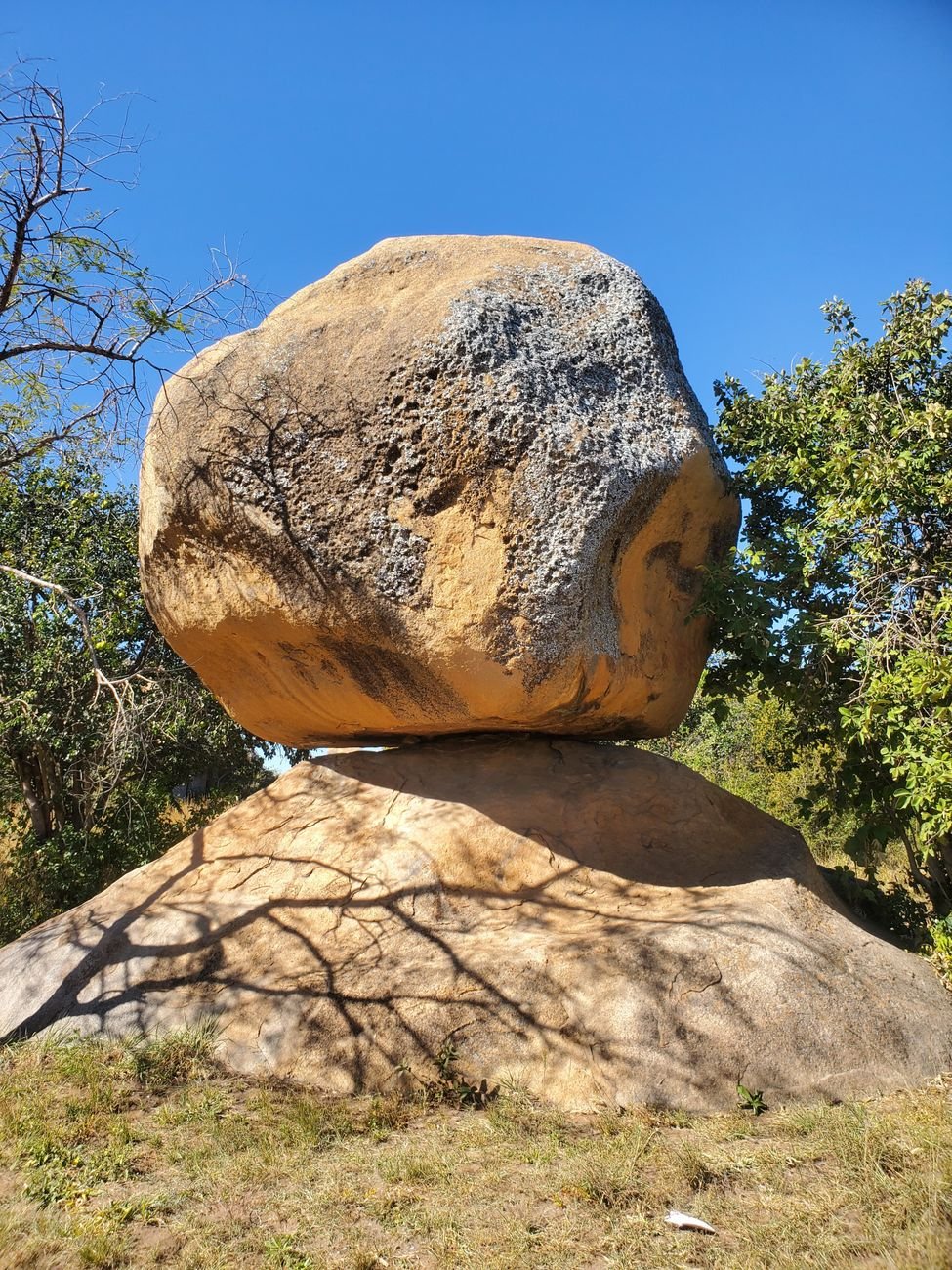
If you are basing yourself in or near Matobo Hills rather than driving out from Bulawayo each day, the national park and its surroundings offer a concentrated set of genuinely excellent activities. White rhino tracking is the headline - and justifiably so - but the balancing rock landscapes, San Bushman rock art, and World’s View all reward a full day or more of exploration. Here is how to approach each.
White Rhino Tracking on Foot
Matobo National Park holds one of the densest populations of white rhino in Africa. The tracking experience is conducted on foot in small groups with a licensed Zimbabwe National Parks guide and ranger, approaching rhino to within close range - typically 20–30 metres. This is wildlife encounter in the most direct sense: no vehicle, no glass, no distance. Just open scrub and a two-tonne animal.
How the tracking works: Groups leave in the morning (approximately 6–8am) before the day gets hot. The guide radios current rhino positions from scouts who monitor the animals daily. The walk can cover 3–8 km of rocky, open terrain depending on where the rhino are. You may walk 10 minutes or 90 minutes before reaching them. When you do, the group stops and the guide positions you carefully for the approach.
What makes it exceptional: White rhino are relatively placid compared to black rhino, but they are enormous and their eyesight is poor - they rely on smell and sound. The tracking guide manages the wind direction throughout the approach. When you get to within 20 metres of a resting group, the silence and scale are memorable in a way that a vehicle encounter cannot replicate.
Booking: Through Zimbabwe National Parks, your Matobo Hills lodge, or Bulawayo-based operators such as Thaba Hills Lodge guides or Bulawayo-based wildlife operators. Groups are capped at 6. In dry-season peak (July–September), book weeks in advance.
Cost: Rhino tracking permit approximately USD 45–60 per person as of 2026, on top of national park entry (approximately USD 15 per person). Total: approximately USD 60–80 per person excluding accommodation and transport.
What to bring: Neutral clothing, closed footwear, 1.5L water minimum, sun hat, sunscreen. Camera with a telephoto lens if you have one. No bright colours, no perfume.
World’s View and Cecil Rhodes’ Grave
World’s View is a granite summit in the central part of Matobo National Park. Cecil Rhodes - who governed much of southern Africa from his Cape Colony base and whose British South Africa Company carved up the region in the late 19th century - asked to be buried here. He died in 1902 and his grave lies under a flat rock inscribed with his name. The Ndebele warrior-king Mzilikazi and Leander Starr Jameson are also buried nearby.
The view: The name is not exaggerated. The summit commands a 360-degree panorama over the Matobo kopje landscape - a sea of rounded granite boulders and mopane woodland stretching to every horizon. Sunrise and late afternoon provide the best light. Even at midday the views justify the short walk up.
The walk: From the car park to the summit is approximately 200 metres of stepped granite - steep in places but manageable for most visitors in 10–15 minutes. The path is rocky; closed shoes are recommended over sandals.
Context for the visit: The decision to bury Rhodes here was and remains controversial in Zimbabwe. A helpful way to approach the site is to bring it in context: Matobo Hills was sacred to the Ndebele people, the ancestors of whom Rhodes’ armies fought in the late 19th century. The site holds multiple layers of history and some of the most striking landscape in the country.
Practical note: World’s View is inside the Matobo National Park fee zone. Park entry (approximately USD 15 per person) applies. The drive from the park gate to the World’s View car park takes around 20 minutes on a gravel road.
San Bushman Rock Art
Matobo Hills has one of the highest concentrations of San (Bushman) rock art in the world - thousands of individual painted panels across the kopjes. The paintings use red, white, and yellow ochre and depict eland, rhino, elephant, human figures, hunting scenes, and imagery linked to shamanic ritual and trance states.
Key accessible sites:
- Nswatugi Cave: One of the best-preserved and most easily accessible sites in the park. The frieze runs along a deep granite overhang and depicts a large number of animals and human figures in good condition. A national parks guide is on-site.
- Pomongwe Cave: Larger than Nswatugi, with paintings across a wide area. A small museum case at the site provides additional context on San culture and belief.
- White Rhino Shelter: Smaller but notable for its rhino paintings - particularly resonant given that living white rhino still share the same terrain.
Guided interpretation: Do not visit the rock art sites without a guide if you have not studied San imagery. The paintings look abstract without context - with a knowledgeable guide, they become a window into a coherent belief system and a specific way of relating to the animal world. National parks guides are available at each site; tip approximately USD 5–10 for a 1-hour interpretation.
Photography: Permitted at most sites. Do not touch the paintings under any circumstances - even clean hands carry oils that accelerate deterioration.
Balancing Rocks Walks
The Matobo landscape produces one of its most visually striking features - granite boulders perched on each other at angles that look structurally impossible. These balancing rocks form because of a process called exfoliation: the outer layers of granite crack and shed as temperatures change, gradually rounding the boulders into spheres that settle and balance.
Walking among them is a standalone experience. The Silozwane area has particularly dramatic stacks. There is no fixed trail - your guide will lead you through the formations, explaining the geology and pointing out smaller details (embedded quartz veins, lichen patterns, embedded San paintings on sheltered surfaces).
Duration: Allow 2–3 hours for a balancing rocks walk. The terrain is uneven - wear closed footwear. The walks are not strenuous but require care on sloped granite surfaces, particularly after rain.
Combining Activities in a Single Day
A well-structured day in Matobo Hills could include:
- 6–7am: Early rhino tracking session (2–4 hours)
- 10–11am: Return to lodge for breakfast
- 12pm: Drive to Nswatugi Cave for rock art with a guide (1 hour)
- 2pm: Drive to World’s View for Rhodes’ grave and the panorama (1 hour)
- 4pm: Return to lodge or sunset drink at the lodge viewpoint
This is a full but manageable day. The key is to book rhino tracking in advance and leave everything else flexible around it.
Practical Information
Getting to Matobo Hills: Approximately 35 km south of Bulawayo city centre on the R4 road. Drive time 40–45 minutes. There is no public transport to the park gate - private vehicle, hire car, or taxi required.
Accommodation: Several lodges operate within or adjacent to the national park. Thaba Hills Lodge is one of the better-regarded options in the area. The national parks also operate a basic camp inside the park - contact Zimbabwe National Parks for current rates and availability.
Guides: Zimbabwe National Parks rangers and licensed guides are essential for rhino tracking and add significant value on rock art sites. Private guides are available through lodges. Tipping approximately USD 10–20 for a half-day guide is standard. You can also browse Matobo Hills tours on GetYourGuide to compare guided day trips departing from Bulawayo.
Best season: May–October (dry season). Vegetation is lower, tracks are passable, and rhino are more visible. The wet season (November–April) brings lush green landscapes and bird activity, but some park tracks become impassable and the long grass makes wildlife harder to spot.
For accommodation options as a base for your Matobo Hills days, search hotels near Matobo Hills on Booking.com.