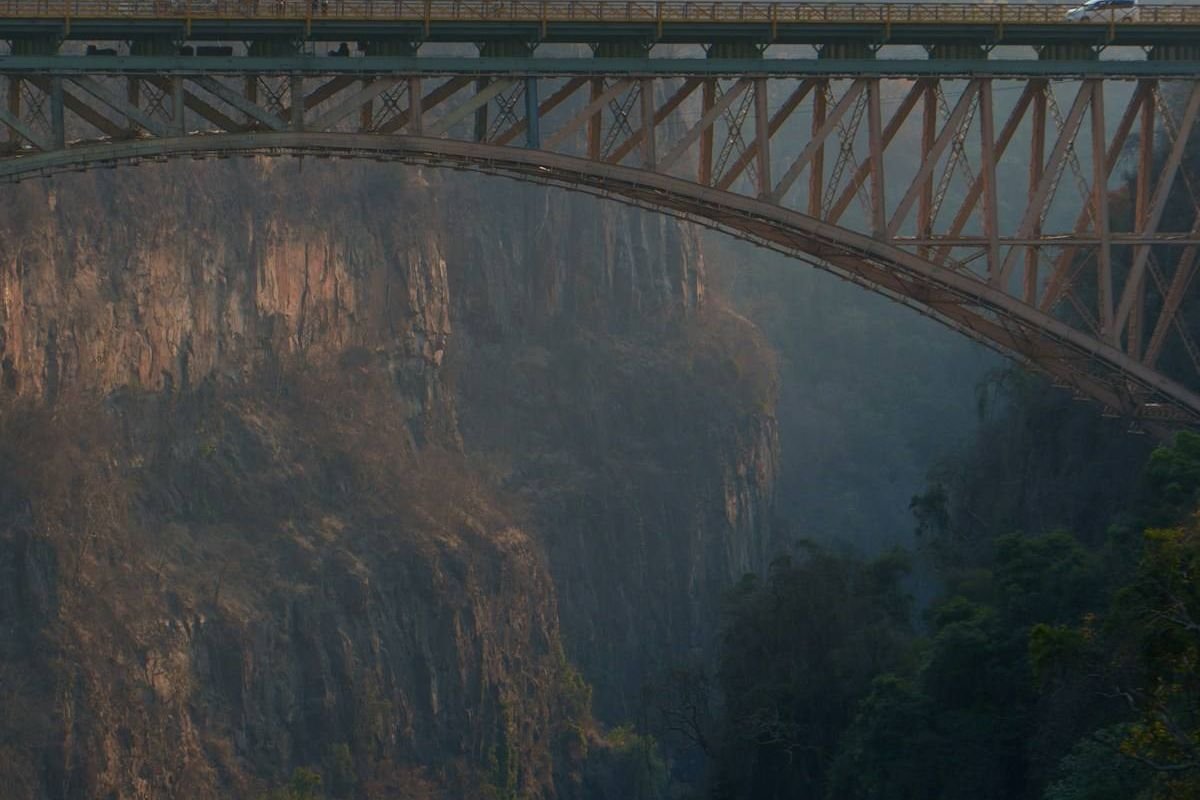
Victoria Falls Bridge is the steel arch that links Zimbabwe and Zambia across the Batoka Gorge, about 2 km downstream of the main falls. It is a border crossing, a heritage landmark, and the platform for the region’s best-known adrenaline jumps. Most visitors see it three ways: a quick walk to the middle for the view, the Shearwater historical tour beneath the deck, or a jump off it. This guide covers all three, plus the Lookout Cafe and the paperwork. For the wider town, start with our Victoria Falls guide.
Victoria Falls Bridge at a glance, with approximate prices as of 2026:
| Item | Detail |
|---|---|
| Location | Batoka Gorge, about 2 km downstream of the main falls, linking Zimbabwe and Zambia |
| Opened | September 1905 |
| Deck height | Approximately 111 m above the Zambezi at low water |
| Historical bridge tour | About USD 64 per person, approximately 2 hours |
| Bridge bungee | USD 160 per jump |
| Best time to visit | Late afternoon, 4:00 to 5:30pm |
| Border note | Allow 30 to 45 minutes to cross back from Zambia in the late afternoon peak |
History: Why the Bridge Exists
The bridge was built as part of Cecil Rhodes’s vision of a railway from the Cape to Cairo. Sections were fabricated in England and shipped out, and the bridge opened in September 1905. It was designed by George Andrew Hobson and built by the Cleveland Bridge and Engineering Company of Darlington. Construction advanced from both sides of the gorge, with the two halves of the arch meeting in the middle.
The figures are worth knowing before you stand on it: the arch spans roughly 156 metres, the deck is approximately 111 metres above the Zambezi at low water, and the bridge is about 198 metres long. Rhodes reportedly wanted the spray of the falls to wash over passing trains, which is why the crossing sits so close to the cataracts. It carries road and rail traffic today alongside pedestrians.
The Historical Bridge Tour
Shearwater runs a guided Victoria Falls Bridge tour that takes small groups along the catwalks beneath the deck, an area closed to the public. You wear a harness, clip onto a safety line, and walk through the steel latticework while the guide explains how the bridge was built and why it mattered.
- Price: about USD 64 per person as of 2026 on Shearwater’s own listing; resellers add a transfer fee, so compare what is included.
- Duration: approximately 2 hours including the presentation.
- Fitness: easy, but you must be comfortable with heights and open grating.
- Bring: your passport, closed shoes, and a camera on a wrist strap. Loose items are not allowed on the catwalk.
To compare other guided options in town, browse Victoria Falls tours on GetYourGuide.
Walking to the Middle: Border Rules
You can walk out onto the bridge on foot. The route runs from the Zimbabwe border post, over the deck, to a spot roughly mid-span where the two countries meet. Expect the following:
- Go through the Zimbabwe border post and show your passport. You may be issued a bridge pass or an exit stamp, depending on the officer and the day.
- Tell the officer you are only walking to the middle. Several recent traveller accounts mention a nominal fee at the post, others none, so carry a few small US dollar notes and ask.
- Walk across no-man’s land, the stretch between the two border posts. This is where the jump platform and the best views of the gorge are.
- To go further into Zambia you must clear Zambian immigration and hold a valid visa. Return the same way, and keep your pass or stamp until you are back in Zimbabwe.
Official guidance from Visit Zimbabwe covers the walk, and details can shift, so treat our description as a guide and confirm at the post.
KAZA UniVisa
If you plan to cross fully into Livingstone and return, the KAZA UniVisa at approximately USD 50 covers both countries and is usually cheaper than buying separate visas. It is issued by Zambia at its border post and online. For nationalities and conditions see our Zimbabwe visa requirements page, and for a full day on the Zambian side see the Livingstone day trip.
The Lookout Cafe
The Lookout Cafe perches on the rim of the Batoka Gorge near the bridge, run by Wild Horizons. It serves lunch and sunset drinks, and the terrace looks straight down into the gorge and across to the bridge arch. It is also the base for the gorge swing, flying fox and zipline, so you can eat while watching others drop. A small park fee (around USD 3) is usually charged on entry. Booking a table at sunset in the dry season is sensible, and it is a good stop to pair with the bridge walk.
Bungee, Swing and Zipline
Three adrenaline options use the bridge or the gorge beside it:
- Bridge bungee: a 111-metre drop from the middle of the bridge, run by Shearwater at a flat USD 160 as of 2026. Read the bungee jumping guide for weight limits and booking. You can book the bridge bungee jump online.
- Bungee swing and slide: a package combining swing and slide elements from the bridge. Check the bungee, swing and slide package.
- Gorge swing, flying fox and zipline: run from the Lookout Cafe side. Recent listings show roughly USD 120 to 135 for a solo gorge swing, USD 95 to 110 for the zipline and USD 55 to 70 for the flying fox. Prices vary by operator, so confirm before you book. Compare costs on our activities and prices page.
Practical Tips
- Best time: late afternoon, between 4:00 and 5:30pm, for softer light and fewer tour buses.
- Wet season: February to June, spray can drench the deck and obscure the falls. Pack a rain jacket.
- Crossing back: queues build in the late afternoon peak, so allow 30 to 45 minutes if you went into Zambia.
- Combine it: pair the bridge with Devil’s Pool on the Zambian side in low water.