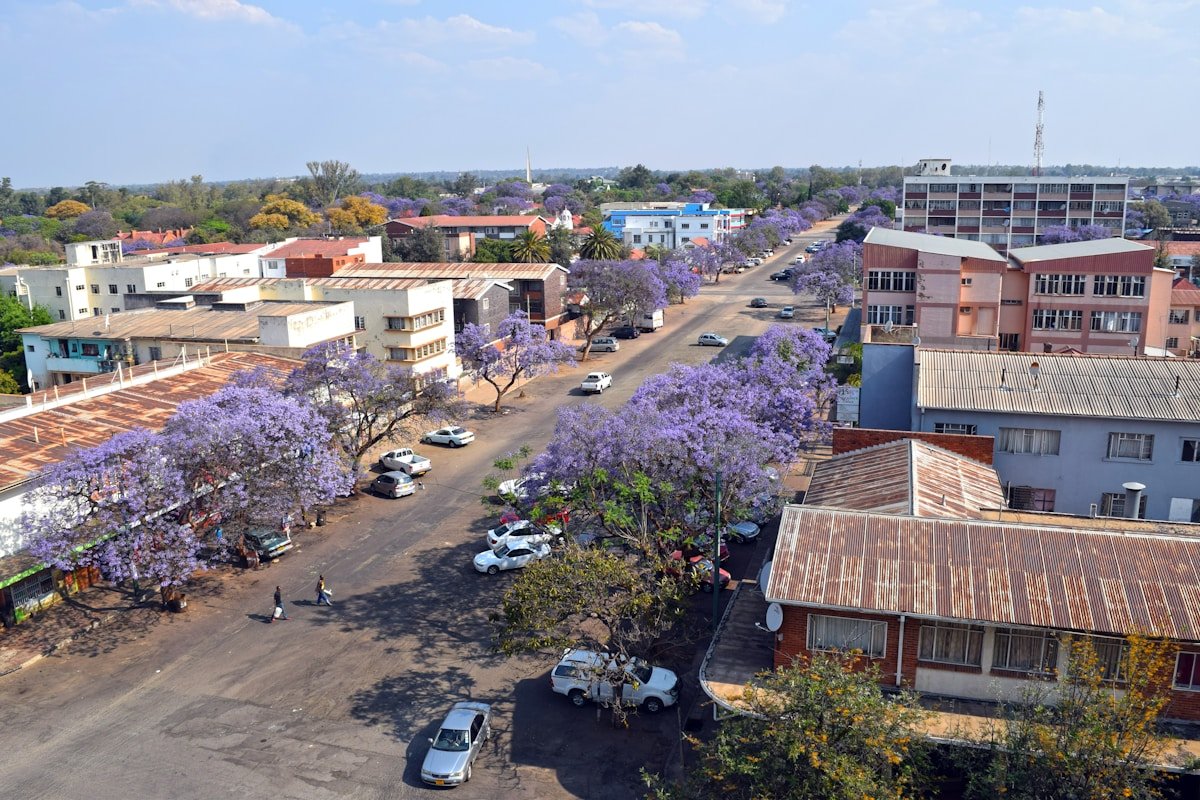
Bulawayo is Zimbabwe’s second city and, in many ways, its most manageable: a wide-street colonial grid, a modest scale, and distances that do not punish you. Getting around the city centre is straightforward. The main challenge is transport to destinations outside town - Matobo Hills especially - where public options are limited.
Joshua Mqabuko Nkomo International Airport to the City
Bulawayo’s airport sits 24 km north-east of the city centre. The drive along the Nketa and Joshua Nkomo roads takes 25–35 minutes.
Private taxis: Wait outside the arrivals hall. Fares to the city centre or inner suburbs are approximately USD 15–25 per vehicle as of 2026. Agree the fare before getting in - meters are not universal.
Pre-booked transfers: Most guesthouses and hotels will arrange a pick-up at similar or slightly higher rates. Worth booking if you are arriving late in the evening.
No public bus from the airport: There is no regular scheduled bus service between the airport and city. Taxis are the only reliable option.
Walking in the City Centre
Bulawayo’s city centre is genuinely walkable. The original city plan used unusually wide avenues - legend has it they were designed wide enough to turn an ox-wagon team without backing up. This makes it an open, navigable space.
Walkable from the CBD:
- Natural History Museum of Zimbabwe (Centenary Park, 1 km from Main Road)
- Bulawayo Railway Museum (Josiah Tongogara Street, 1.5 km from CBD)
- Bulawayo City Hall and the historic main streets
- Bulawayo Public Library
Practical note: Stick to the main streets during daylight. The CBD is active and generally safe during business hours. After dark, take a taxi for any journey beyond your immediate hotel block.
Commuter Buses and Kombis
Bulawayo has a commuter bus and kombi (minibus) network connecting the centre to the outer suburbs. The main terminals are:
- Egodini Bus Terminal (Lobengula Street and Third Avenue junction) - the major kombi hub for routes going south and west
- Renkini Bus Terminal - for longer intercity routes to Harare, Victoria Falls, and Johannesburg
Fares: Intra-city kombi routes cost USD 0.30–0.80 per person as of 2026. Kombis are used by most Bulawayo residents but require knowing which vehicle to board - the route is shouted by the conductor. Useful for the inner suburbs (Suburbs, Queens Park, Hillside) but not practical for day trips outside town.
InDrive: InDrive operates in Bulawayo to a limited extent. Driver availability is lower than in Harare - the app works but you may wait longer for responses, especially outside peak hours. Still worth trying for city-centre trips.
Taxis in Bulawayo
Traditional taxis are the most reliable option for getting around Bulawayo, particularly for journeys beyond the walking radius.
Where to find taxis:
- Outside Bulawayo City Hall (Leopold Takawira Avenue)
- At the Central Park area
- Outside the Holiday Inn and main hotels
- Around the market area
Typical fares (2026):
- Short CBD trip (under 3 km): USD 3–6
- CBD to Suburbs or Hillside: USD 6–10
- CBD to Burnside or Matsheumhlope: USD 8–12
- Airport transfer: USD 15–25
After dark: Take a taxi rather than walking or using an unfamiliar kombi after dark. Ask your accommodation for a recommended driver.
Getting to Matobo Hills National Park
Matobo Hills is the most important day trip from Bulawayo - and the one that most requires planning since public transport does not reach the park entrance.
Distance: Approximately 35 km south of Bulawayo city centre, 40 minutes on a sealed road.
Options:
By organised tour: The most convenient choice, especially for rhino tracking. Tour operators in Bulawayo run half- and full-day trips combining the park entrance with a guided rhino tracking walk. Ask your accommodation; most guesthouses in Bulawayo maintain relationships with local guides. Approximate cost: USD 80–150 per person for a full-day guided trip including park fees.
By private hire taxi: A return taxi from Bulawayo to Matobo, including 3–4 hours of waiting while you explore, costs approximately USD 40–70 as of 2026. The driver waits at the park gate. This gives you more flexibility than a group tour but you will need your own guide inside the park for rhino tracking.
Self-drive: The easiest option if you have a hire car. The R4 Bulawayo–Fort Usher road runs directly to the park entrance. Signage is reasonable. A compact car is sufficient for the sealed park roads; a 4WD is recommended if you plan on gravel tracks in the western sections of the park. Car hire in Bulawayo is discussed below.
Park entry fees: Non-resident entry approximately USD 15 per person plus USD 5 per vehicle as of 2026. Check current Zimbabwe National Parks fees before visiting.
Rhino tracking: This is a guided activity booked through Zimbabwe National Parks or through certified operators. Groups are small (6 people maximum). The walk typically runs 2–4 hours. Cost approximately USD 45–60 per person for the tracking permit as of 2026, on top of park entry. Book in advance - slots fill quickly, especially in the dry season (May–October).
Getting to Khami Ruins (UNESCO World Heritage Site)
Khami Ruins sit 22 km west of Bulawayo city centre, accessible by road in 25–30 minutes. Like Matobo, there is no public transport to the site.
Options: Private hire taxi (USD 20–35 return with waiting), self-drive, or combined tour. The ruins can be visited in 1–2 hours and make a good half-day combined with lunch back in the city.
Site notes: Khami Ruins are one of the most significant archaeological sites in Zimbabwe - a stone-walled city of the Torwa state, dating from approximately the 15th century AD. A national parks guide is available on-site and adds considerable context.
Car Hire in Bulawayo
Hiring a car is the most practical option if you plan to visit Matobo Hills, Khami Ruins, and the wider area under your own steam.
Car hire options in Bulawayo:
- Avis Bulawayo - at the airport. Rates from approximately USD 60–80 per day for a small car as of 2026
- Europcar - airport location; check current availability
- Local operators - several informal car rental operations exist in Bulawayo; your guesthouse can recommend current trusted providers
What you need: Valid driving licence, credit card for deposit, and third-party insurance (usually included in the hire package).
Road conditions: The road to Matobo Hills is sealed and in reasonable condition. The roads inside the park vary - the main access road is gravel but passable in a saloon car. Carry water and don’t rely on fuel or phone signal once inside the park.
Practical Notes
Cash: Keep USD 1 and 5 notes for taxis and kombis. Card machines exist but are unreliable for transport.
Fuel: Fill up in Bulawayo before heading to Matobo or Khami - fuel stations inside and near the parks are limited.
Communication: Most Bulawayo suburbs have reasonable mobile data. Inside Matobo National Park, signal is sparse. Download offline maps before you leave your accommodation.
For accommodation options in Bulawayo, search hotels in Bulawayo on Booking.com.