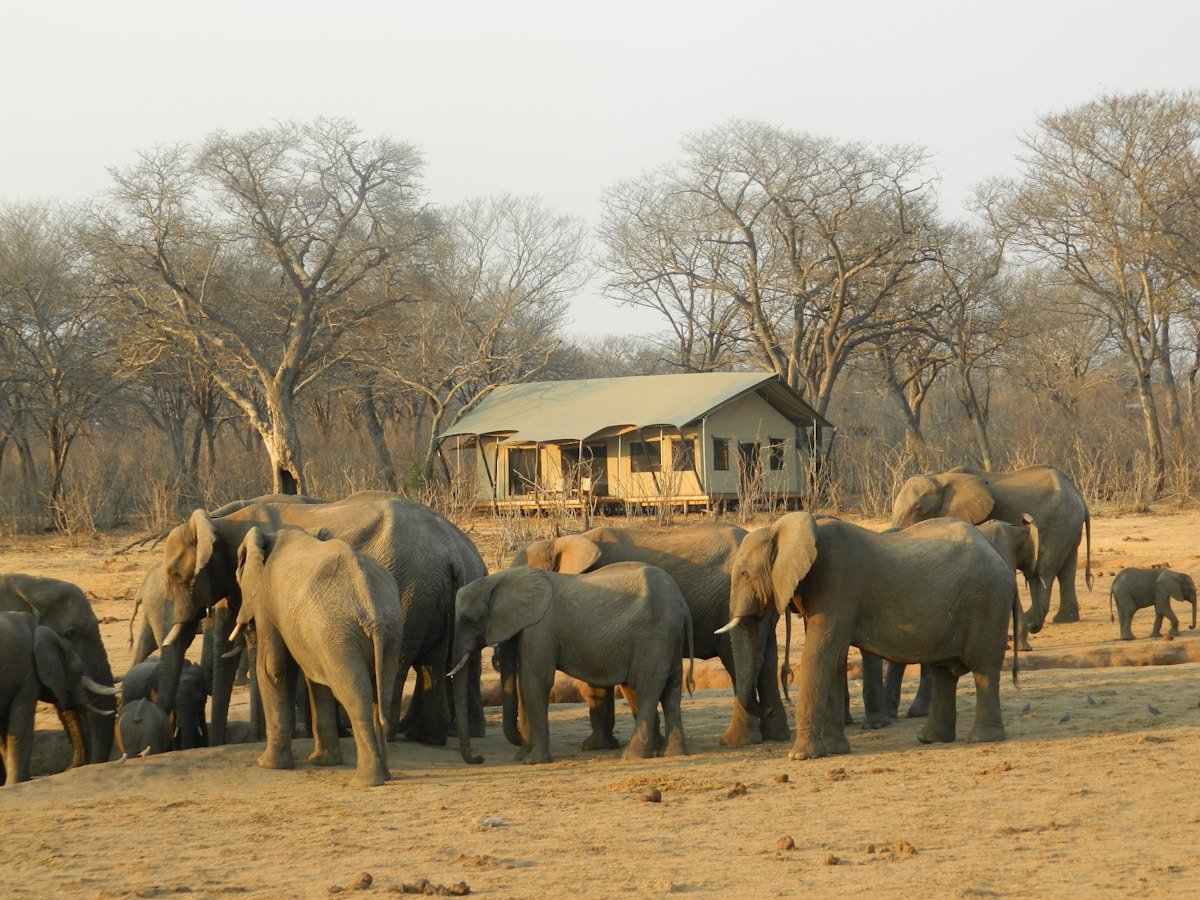
Hwange National Park is one of the great wildlife destinations in Africa - not because it is the most exclusive or the most scenic, but because what it delivers in sheer volume of wildlife is almost unmatched. Come in the dry season, sit at a waterhole, and wait. The elephants will arrive in family groups of ten, then thirty, then hundreds. By September in a good year, you may be looking at over a thousand animals at a single pan. This is Hwange’s defining spectacle.
The Elephants
The headline attraction is also the one that genuinely lives up to the billing. Hwange’s elephant population of approximately 40,000–45,000 is one of the highest densities relative to park area in Africa, and the park’s system of solar-powered artificial waterholes - installed to compensate for the limited natural water in this semi-arid ecosystem - concentrates them in predictably viewable locations.
Hyde’s Hide at Main Camp is the most accessible waterhole and is visible from the national park camp. Elephants are present most mornings and evenings from May onward, with numbers peaking August–October. Communal hides overlook the pan; arrive early for the best light.
Nyamandhlovu Platform is the standout game-viewing hide in the national park’s public areas - an elevated wooden platform overlooking a large waterhole about 12 km from Main Camp. The viewing structure allows close approach of animals without vehicle disturbance, and the waterhole is lit for limited night viewing. Access requires a park vehicle or self-drive - a park guide is available from Main Camp to accompany guests.
Dom Pan and Ngweshla Pan (Linkwasha concession area) are the preferred waterholes for guests at the private lodges in the south of the park. Ngweshla in particular has been one of Hwange’s most reliable spots for large elephant aggregations in the September–October period.
Lions and Big Cats
Hwange has a healthy and well-documented lion population - individual prides have been monitored by researchers for decades. The Hwange Lion Project (based at the park) has tracked multiple generations of the same prides and has contributed to understanding lion social dynamics across Africa. Cecil the lion, whose death in 2015 brought global attention to trophy hunting issues in Zimbabwe, was a Hwange lion.
Lions are most reliably seen from private concession camps with experienced guides who know territorial ranges. The Linkwasha and Somalisa concessions have produced consistent sightings. Expect pride groups of 5–15 animals in typical viewing; kills are occasionally witnessed near waterholes.
Leopard sightings are far harder to engineer. They are present throughout the park but secretive. Night drives from private camps offer the best chance.
African Wild Dogs
Hwange is one of the best places in the world to see African wild dogs (painted dogs). The Hwange wild dog population fluctuates - disease, human-wildlife conflict on the boundaries, and territorial dynamics all play a role - but when packs are active near camps the sightings are extraordinary.
The Oxford University WildCRU programme (the same team that studied Cecil) has also run long-term painted dog research in Hwange, contributing to understanding of pack movements. Ask your camp’s guide about recent pack activity; this is more reliable than any published guide.
The denning season (June–August) is particularly exciting: if a pack is denning near a camp, it is possible to watch pups emerge at dawn and dusk with predictable regularity.
Buffalo Herds
Buffalo form large herds in Hwange during the dry season - groups of several hundred are regularly encountered near waterholes, particularly around the Sinamatella and Robins areas. A herd of 500 buffalo moving toward a waterhole at dusk is one of those encounters that reminds you why Hwange is in the same conversation as Serengeti or Chobe.
Birdlife
Hwange’s bird list exceeds 400 species, making it a serious birding destination regardless of the large mammals. Highlights include:
- Kori bustard (Africa’s heaviest flying bird, common on open pans)
- Bateleur eagle (distinctive red-faced raptor, seen regularly soaring above woodlands)
- African fish eagle (near waterholes and the Dete Vlei area)
- Bradfield’s hornbill and Racket-tailed roller (both Hwange specialities, near Robins Camp)
- Arnott’s chat (a localised special in the mopane woodlands)
The Dete Vlei - a shallow seasonal pan near the main road - is excellent for waterfowl during the wet season (December–March).
Walking Safaris
Most private camps offer walking safaris with licensed professional guides. Walking in Hwange is a fundamentally different experience from a vehicle game drive: the pace is slower, the sensory engagement is higher, and the tension of being on foot in lion country is real. Good walking guides narrate not just the large mammals but the ecosystem: insect nests, plants used by local communities, animal tracks and signs, the relationship between termite mounds and the woodland canopy.
Recommended operators for walking: Miombo Safaris, Elephants Eye Lodge, and most Wilderness Safaris properties. The national park also runs guided walks from Main Camp (approximately USD 20 per person as of 2026) - these are good value but cannot match a private camp’s bespoke approach.
Game Drive Circuits
Main Camp circuit: Accessible to self-drive visitors, the roads around Main Camp cover open grass plains and mopane woodland. The circuit past Hyde’s Hide, along the Masuma Dam road, and back via Mbiza Road covers the best waterhole territory. Best done in the first two hours after dawn.
Sinamatella circuit: More remote and less well-marked but rewarding. The valley viewpoints from Sinamatella Camp itself are a highlight - scan for lion and buffalo below in the early morning.
Private concession drives: Exclusive to guests of the relevant camps; the roads are better maintained and guides have years of accumulated knowledge about animal ranges and individual animals. The quality of guiding here is typically outstanding.
What to Set Your Expectations On
Hwange is not a compact, easily ticketed wildlife experience. The park is vast, the bush is thick in the wet season, and wildlife does not always appear on cue. What it delivers, especially from August onward in a dry year, is a genuine sense of African wilderness combined with the reliable spectacle of the waterhole system. Give it at least two full game-drive days and you are very unlikely to leave disappointed. For those arriving without a booked private camp, Hwange full-day safari tours are bookable via GetYourGuide - a practical option that includes transport, a guide, and park fees. For accommodation options in and around Hwange, search hotels in Hwange on Booking.com.