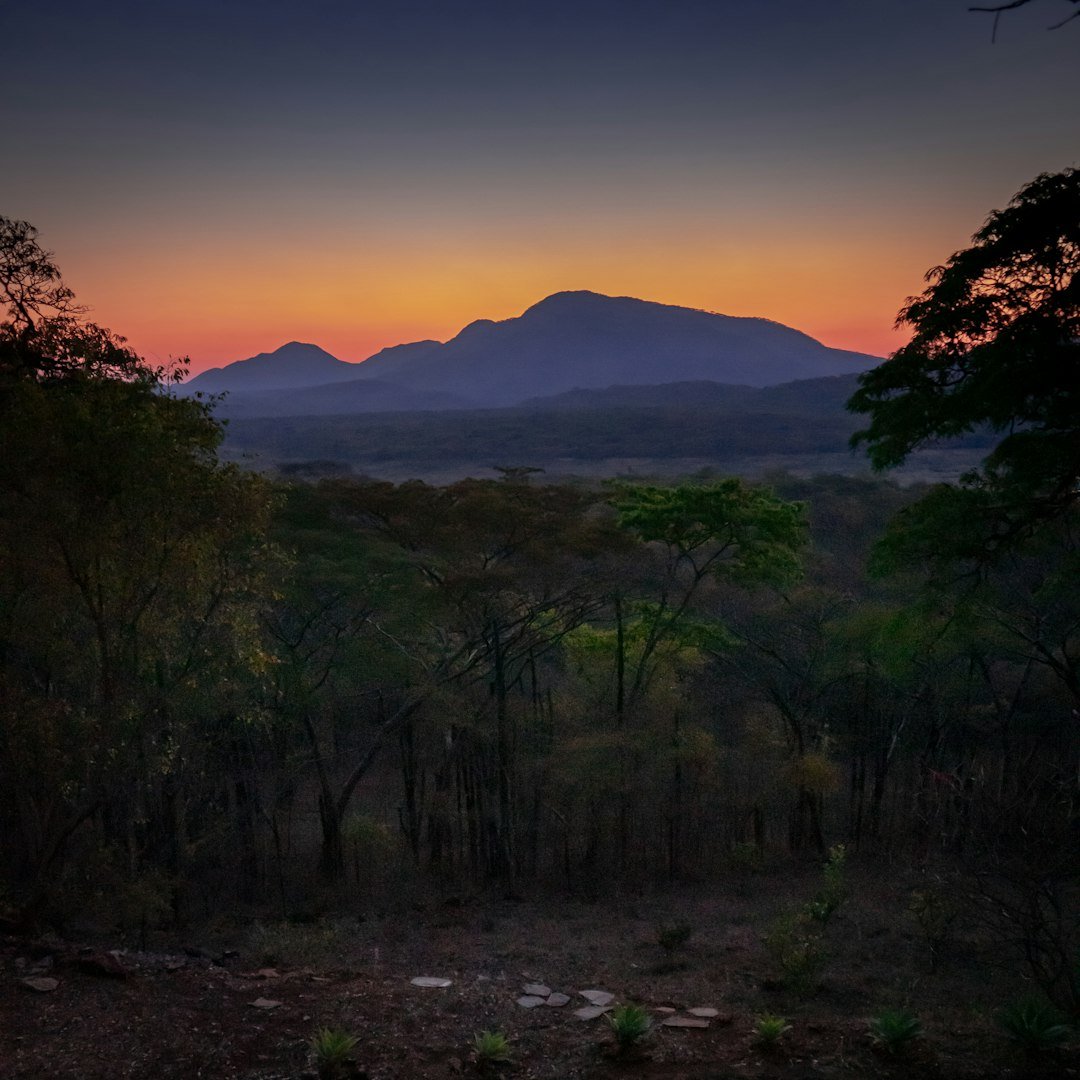
Zimbabwe’s Eastern Highlands are the country’s best-kept geographic secret: a mountain range that rises sharply from the Mozambique border to heights above 2,500 metres, producing a landscape of mist, streams, tea plantations, pine forests, and rocky peaks that feels entirely unlike the savanna that defines the rest of the country. Temperatures here are cool by Zimbabwean standards (summer highs of 22–26°C; winter nights dropping below 5°C), rain is reliable from November to March, and the walking is some of the finest in southern Africa.
The highlands divide naturally into three areas: Nyanga in the north, the most developed for tourism; Bvumba (Vumba) near Mutare, known for botanical gardens and misty forest; and Chimanimani in the south, the most dramatic and the most remote.
Nyanga: Mountains, Waterfalls and Trout
Nyanga National Park contains Zimbabwe’s highest peak, Mount Nyangani (2,592 metres), the Nyangombe Falls - a series of cascades through a sculpted granite gorge - and Mutarazi Falls, Africa’s second-tallest waterfall at 762 metres.
Climbing Mount Nyangani is a 5–6km return hike from the car park at the mountain’s base, gaining approximately 600 metres of elevation on a marked trail. The summit is often in cloud from midday onwards; start by 7am for the best chance of clear views. The area is considered spiritual by local Shona communities, and the mountain has a well-documented history of unexplained disappearances - take the trail markers seriously and do not stray from the path.
Trail entry: USD 10 per person as of 2026. No technical equipment required, but proper hiking boots are essential - the upper slopes can be slippery on wet rock.
Mutarazi Falls requires a drive along the Honde Valley Escarpment Road - one of Zimbabwe’s finest scenic drives. From the Mutarazi Falls car park, a short walk leads to the viewpoint at the falls’ lip, where the Mutarazi River drops vertically 762 metres into the Honde Valley below. The best flow is from December to April; by September the falls thin considerably. Drone photography is prohibited without a permit.
Trout fishing in Nyanga centres on Nyanga Dam and Udu Dam, both stocked with brown and rainbow trout. Fishing access is through Troutbeck Resort, which manages much of the dam shoreline. Rod hire and guided sessions are available from approximately USD 25–40 per person per session. The upper Nyangombe River is open for fly fishing by permit from Zimbabwe National Parks.
Where to Stay in Nyanga
Troutbeck Resort (from approximately USD 150 per room per night bed and breakfast) is a colonial-era resort set on a lake at 1,830 metres, with its own 18-hole golf course, horse riding, trout fishing, and well-maintained woodland walks. The dining room serves solid highland cooking (dinner mains from USD 12–20 as of 2026).
Montclair Hotel and Casino (from approximately USD 85 per room per night) in Nyanga village is more straightforward - a useful base for Nyangani hikes and Mutarazi Falls day trips, with a reasonable restaurant (mains USD 8–14) and Wi-Fi.
Zimbabwe National Parks’ Nyanga Rest Camp (chalets from approximately USD 35–55 per night) sits within the national park, well placed for early morning hikes. Search Nyanga accommodation on Booking.com for current rates across all options.
Chimanimani: The Wilderness Backpacker’s Range
Chimanimani National Park (entry USD 15 per person as of 2026) is the wildest part of the Eastern Highlands: a compact range of quartzite peaks, deep river gorges, natural caves, and high-altitude grassland with no roads inside the park boundary. All exploration is on foot.
The classic route is the Base Camp Trail from the park boundary at Mutekesswane, 18km from Chimanimani village, to the thatched Base Camp hut - a 3–4-hour walk. From Base Camp, day hikes access Skeleton Pass (a dramatic ridge crossing into Mozambique; passports required), the Bailey’s Folly waterfall, and the Bridal Veil Falls near the village.
A multi-day traverse of the main range - sleeping at Base Camp and in natural cave shelters - is one of southern Africa’s finest wilderness walks. Distances are short but altitude gain is significant and the quartzite rock is grippy. No guided requirement, but a local guide hired in Chimanimani village (approximately USD 15–25 per day) adds safety and route knowledge.
Cyclone Idai in 2019 caused significant landscape change in Chimanimani - several trails were modified and the village was severely damaged. Check current trail conditions before visiting.
Where to Stay in Chimanimani
Chimanimani Hotel (from approximately USD 55 per room per night) in Chimanimani village is the main accommodation option - recently refurbished, with a restaurant serving straightforward meals (mains USD 7–12). Chimanimani Eland Sanctuary chalets (from approximately USD 40 per night) provide a more rustic bush-camp atmosphere on the park boundary. Check Chimanimani accommodation availability on Booking.com.
The Bvumba (Vumba) Mountains
Midway between Mutare and Chimanimani, the Bvumba range is known for its Vumba Botanical Gardens (entry USD 5 as of 2026; open 8am–5pm), a collection of indigenous and exotic trees set in a dramatic mist-forest landscape. Tony’s Coffee Shop inside the gardens is a favourite stop for travellers on the Chimanimani road.
Leopard Rock Hotel (from approximately USD 200 per room per night) perches on the edge of the Bvumba range with views into Mozambique, a 9-hole golf course, and formal gardens - an unusual luxury-hotel experience in the mountains.
For full accommodation listings across the Eastern Highlands, see our guides for Nyanga, Chimanimani, and Mutare.
Getting Around the Eastern Highlands
The Eastern Highlands are strung along 300km of the Mozambique border, so a vehicle is necessary to move efficiently between areas. Mutare is the gateway - 265km from Harare (3–3.5 hours), with an airport served by Air Zimbabwe (approximately USD 65–100 one-way from Harare). Search Mutare hotels on Booking.com for gateway city accommodation. From Mutare: Nyanga is 105km north (1.5 hours), Bvumba is 25km southeast (30 minutes), Chimanimani is 150km south (2.5 hours).
Zimbabwe’s highlands receive the most reliable rainfall of any region in the country, making the dry season (April–September) the most predictable for hiking, though trails remain walkable year-round. Bring warm layers - temperatures at altitude drop sharply after sunset throughout the year.
For visitors who prefer a guided experience, browse Eastern Highlands tours on GetYourGuide for day hikes, multi-day itineraries, and guided excursions across Nyanga, Bvumba, and Chimanimani.