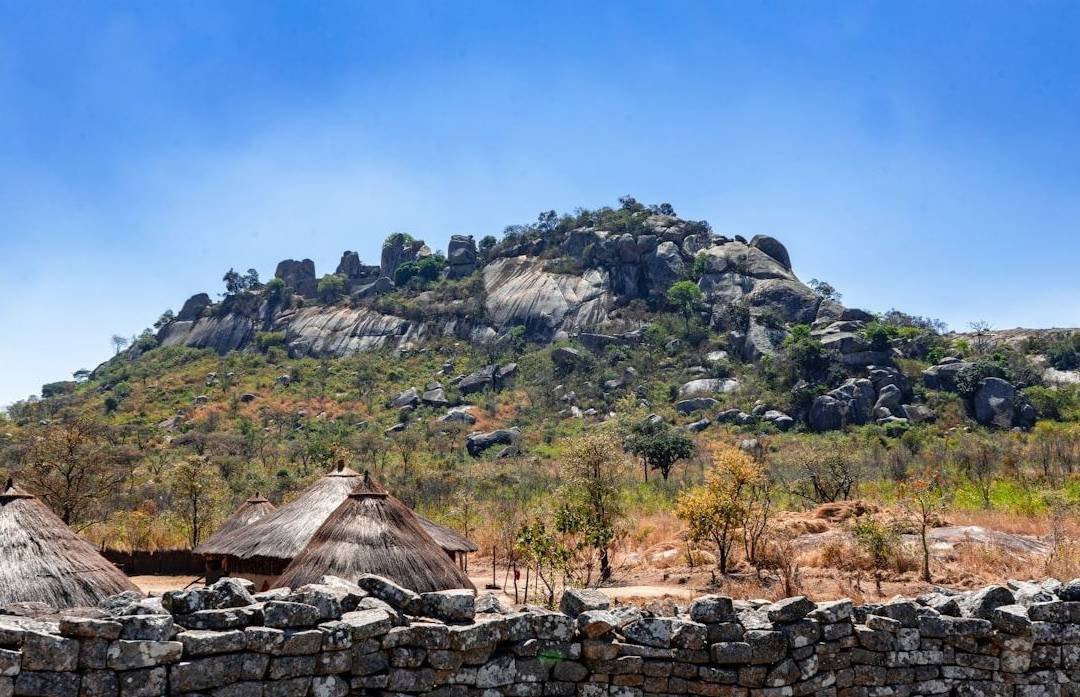
Zimbabwe has five historical sites that reward a detour: Great Zimbabwe, Khami Ruins, the Matobo Hills rock art, World’s View and Victoria Falls Bridge. Together they cover a thousand years of history, from medieval stone cities to San paintings and the colonial railway. Most are within three hours of Bulawayo, Masvingo or Victoria Falls, and entry runs from about USD 5 to 15.
We have visited and written up each of these in depth, so this list is the short version: what each site is, what it costs, how to get there and when to go. Fees are approximate and current as of 2026.
1. Great Zimbabwe
Great Zimbabwe is the largest ancient stone structure in sub-Saharan Africa and the reason the country has its name. The city served as the capital of the Kingdom of Zimbabwe from roughly the 11th to the 15th century, and its walls were built from granite blocks without mortar. The site is a UNESCO World Heritage Site.
The ruins fall into three areas: the Hill Complex, the Great Enclosure and the Valley Ruins. The Hill Complex needs a steep climb of 15 to 20 minutes and gives the best views. The Great Enclosure, with its curved outer wall, is the most photographed part.
- Entry: approximately USD 15 per adult international visitor as of 2026
- Getting there: about 27 km southeast of Masvingo; 3.5 hours by road from Harare, 3 hours from Bulawayo
- Time needed: three to four hours
- Best time: the dry season from May to October, early in the day before the heat builds
Local tip: Hire a guide at the entrance (approximately USD 10 to 15 per group). The enclosures have no labels, and a guide explains what each area was for.
Read the full Great Zimbabwe ruins guide and our Masvingo and Great Zimbabwe hub. You can also book a Great Zimbabwe tour or search hotels near the ruins.
2. Khami Ruins
Khami was the capital of the Torwa state from about 1450 and sits 22 km west of Bulawayo. It is also a UNESCO World Heritage Site, but it sees far fewer visitors than Great Zimbabwe. The builders set platforms against hillsides and decorated the walls with a check pattern that is specific to Khami.
The Hill Complex is the main sight, with a stone staircase up to a platform and wide views over the valley. Below it you can see the Cross Ruin and the Dhlo-Dhlo Depression, where excavations recovered the most trade goods, including Chinese porcelain and glass beads.
- Entry: approximately USD 5 per adult international visitor as of 2026
- Getting there: about 30 minutes by car from central Bulawayo; a return taxi costs approximately USD 20 to 30
- Time needed: one to two hours
- Best time: morning, when it is cooler and the site is quiet
Local tip: A National Parks ranger is usually on site and can give basic guidance, so ask before you set off round the platforms.
Our Khami Ruins guide covers the history in more detail, and the Bulawayo city guide lists places to stay and eat.
3. Matobo Hills Rock Art
The Matobo Hills hold some of the finest San rock art in southern Africa, with the oldest paintings believed to be more than 13,000 years old. The subjects include eland, giraffe, human figures and abstract symbols. The wider landscape is another UNESCO World Heritage Site.
Nswatugi Cave is generally considered the best single site, with a well-preserved giraffe panel. White Rhino Shelter has depictions of white rhino, Bambata Cave is one of the earliest-dated sites, and Silozwane Cave requires a walk of about 3 km return and is best done with a guide.
- Entry: Matobo National Park costs approximately USD 15 per adult international visitor per day as of 2026, with about USD 5 more for a vehicle
- Getting there: about 35 km south of Bulawayo, roughly 45 minutes by road; a high-clearance vehicle helps for remote sites
- Time needed: a half day for two or three caves
- Best time: the dry season, May to October
Local tip: Do not use flash and never touch the rock. Skin oils cause permanent damage to the pigments.
Our Matobo Hills rock art guide lists the sites in order, and the Matobo Hills hub covers the rest of the park. Bulawayo operators run guided trips from approximately USD 80 to 150 per person, or you can browse Matobo tours.
4. World’s View (Cecil Rhodes’ Grave)
World’s View, also called View of the World, is a granite kopje in Matobo National Park where Cecil Rhodes is buried. Leander Starr Jameson and Allan Wilson, who led the Shangani Patrol, are buried there too, and a brass plaque commemorates the patrol.
The site is contested. Rhodes was the architect of British colonial rule in southern Africa, and some visitors come for the history and the panorama while others see the grave as a symbol of dispossession. We cover both views in our Rhodes grave guide, and the wider story sits in the Zimbabwe independence history article.
- Entry: included in Matobo National Park fees, approximately USD 15 per person per day as of 2026
- Getting there: about 35 km south of Bulawayo, around 45 minutes; the last stretch is a steep climb of 15 to 20 minutes each way
- Time needed: one to two hours
- Best time: early morning or late afternoon for softer light over the boulders
Local tip: Combine it with a rock art site on the same day. Most Bulawayo operators run half-day Matobo trips that pair the grave with one or two caves.
5. Victoria Falls Bridge
Victoria Falls Bridge links Zimbabwe and Zambia across the Batoka Gorge, about 2 km downstream of the main falls. The steel arch dates from 1905, spans roughly 156 m and sits approximately 111 m above the Zambezi at low water. It was built as part of the railway line planned from the Cape northwards.
You can walk to the middle after going through the Zimbabwe border post and saying you are only visiting the bridge. There is also a historical bridge tour of about 2 hours, with a short talk and a harness walk along the catwalks beneath the deck, from approximately USD 64 per person as of 2026.
- Entry: free to walk to the middle; rules and any small fee change, so confirm at the border post
- Getting there: a short walk or taxi ride from Victoria Falls town
- Time needed: 30 minutes for the walk, 2 hours for the tour
- Best time: late afternoon for soft light and gorge shadows
Local tip: Entering Zambia proper needs a visa, so keep your passport handy and tell the border officer you are only visiting the bridge. The bridge is also the home of the bungee jump, if the history makes you want a 111 m drop.
See the full Victoria Falls Bridge guide, and browse Victoria Falls tours for guided options.
How to Fit These Sites Into One Trip
Three of the five sites cluster around Bulawayo. Khami, the Matobo rock art and World’s View fit into two days from a base in the city, and our 7-day Zimbabwe itinerary shows one way to pace the country. Great Zimbabwe works as a stop on the road between Harare and Bulawayo. Victoria Falls Bridge slots into any Victoria Falls stay.
For official visitor information, check the Zimbabwe Tourism Authority and ZimParks before you go, since fees and opening hours are adjusted from time to time.