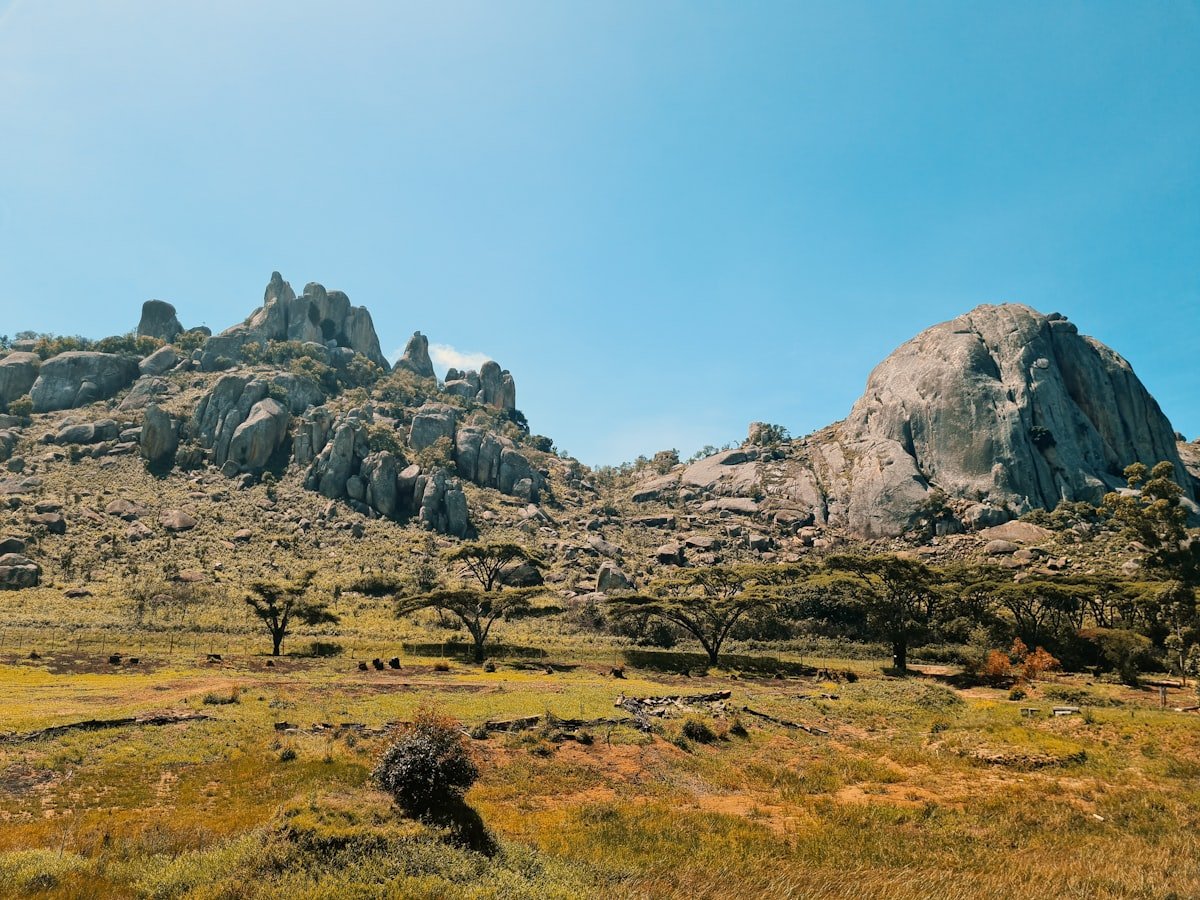
Matobo Hills is unlike anywhere else in Zimbabwe. A UNESCO World Heritage Site recognised for both natural and cultural heritage, it packs granite kopjes, 13,000-year-old San rock paintings, white rhino on foot, and one of Africa’s great viewpoints into a park covering 424 square kilometres, 35 kilometres south of Bulawayo.
The result is a destination that rewards slow travel. Most visitors who come for rhino tracking discover the rock art and stay longer. Give Matobo two nights minimum; three is better.
White Rhino Tracking
Matobo holds one of Zimbabwe’s highest-density white rhino populations, managed inside an Intensive Protection Zone (IPZ) with 24-hour armed rangers. Sighting success rates consistently exceed 85% on guided walks - among the highest of any rhino tracking experience in Africa. All walks are conducted with a ZPWMA-licensed armed ranger; independent tracking is not permitted.
For a full breakdown of operators, costs, difficulty and safety protocol, see our dedicated Matobo Hills rhino tracking guide.
San Rock Art: Nswatugi Cave and White Rhino Shelter
Matobo Hills contains more than 3,000 documented San Bushman rock paintings across the kopjes and cave overhangs, some dating back 13,000 years. Two sites stand out for accessibility and quality of paintings.
Nswatugi Cave
Nswatugi is the most visited rock art site in the park and one of the finest in southern Africa. The main painted panel extends roughly 30 metres along a granite overhang and depicts giraffe, kudu, zebra, and eland alongside human figures engaged in hunting and ritual scenes. The detail and state of preservation are exceptional given the age.
The cave is a short walk from the car park (about 10 minutes on a well-marked path). Admission is included in the standard park entry fee. A Parks Authority guide is available at the site and provides useful context on San cosmology and the significance of specific images - worth taking if you want to understand what you’re looking at rather than simply photograph it.
White Rhino Shelter
White Rhino Shelter takes its name from a large painted white rhino on the main panel - one of the most precisely observed animal images in the Matobo corpus. The site is slightly less visited than Nswatugi, which means you’re more likely to have it to yourself. The shelter holds additional depictions of game animals and human figures, painted in ochre, white, and black using pigments derived from iron oxide and charcoal.
Both sites are located in the recreational area of the park (north of the wilderness zone) and are accessible by standard vehicle. Allow at least one to two hours if you plan to visit both.
World’s View: Cecil Rhodes’ Grave
World’s View (also written Malindidzimu, meaning “dwelling place of spirits” in Ndebele) is a flat granite dome with a 360-degree view across the Matobo boulderscape that draws every category of visitor - hikers, historians, and photographers.
Cecil Rhodes, who governed the British South Africa Company territory that became Rhodesia, requested burial here. He is interred in a rock grave at the summit, alongside Leander Starr Jameson and several others from the Pioneer Column era. The site is deeply contested - Rhodes’ legacy in Zimbabwe is understandably complicated, and the grave sits within a landscape that the Ndebele people have regarded as spiritually significant for centuries.
The view itself is one of the best in Zimbabwe regardless of your view of the history. Sunrise and late afternoon are the best times to visit; the granite heats through the day and radiates warmth into the evening.
The hike from the car park to the summit takes roughly 20 minutes on a well-maintained path with some rock scrambling near the top. Verreaux’s eagles (black eagles) nest on the cliffs below and are frequently visible soaring overhead - Matobo holds one of the highest densities of this species anywhere in their range.
Chapman’s Baobab
Chapman’s Baobab sits at the southern edge of the Matobo region, approximately 15 kilometres inside the park from the Kezi Road entrance. It is one of the largest baobabs in Zimbabwe - trunk circumference exceeds 25 metres - and one of the oldest, estimated at more than 1,000 years.
The tree was documented by explorer James Chapman in the 1850s and appears as a waypoint in multiple Victorian-era exploration journals. Engraved names and dates on the bark trace a lineage of travellers back to the nineteenth century, though carving is no longer permitted.
Chapman’s Baobab is most meaningful visited on its own terms: a living organism older than the Zimbabwean state, older than European presence in this region, standing in an otherwise open savanna. Access requires a high-clearance vehicle on the track from the main park road.
Wildlife Beyond Rhino
Matobo holds leopard in good numbers - the rocky terrain provides ideal cover and denning sites. Sightings are uncommon on foot; dawn game drives give the best chance. Lion are present but range widely across the park and are seen irregularly.
The bird list is exceptional for a park this size. Beyond Verreaux’s eagles at World’s View, look for bataleur, martial eagle, African hawk-eagle, and lanner falcon on the granite cliff faces. The miombo woodland in the southern section holds species absent from open savanna parks: miombo rock thrush, stripe-breasted tit, and miombo pied barbet.
Baboon are extremely common across all areas of the park and habituated to vehicles. Klipspringer - small antelope adapted to rocky terrain - are regularly seen on the kopjes. Zebra, giraffe, and wildebeest move through the grassland areas.
Practical Information
Park entrance fees: approximately USD 15–20 per person per day as of 2026. Verify current rates with Zimbabwe Parks Authority; fees are adjusted periodically.
Opening hours: The park gates open at 06:00 and close at 18:00. No movement permitted inside after sunset; all visitors and vehicles must be out of the wilderness zone by dusk.
Getting there: From Bulawayo, take the Matobo Road south from the city centre. The main park gate (Maleme Dam area) is 35 kilometres from the city, approximately 40–50 minutes by car. Bulawayo Airport (BUQ) has connections from Harare on Air Zimbabwe and Fastjet. Most Bulawayo guesthouses can arrange transfers.
Best season: May to October for rhino tracking, rock art, and general wildlife. November to April is wetter; some tracks become difficult, and rhino visibility drops as grass grows above one metre. Birding improves markedly November to March with migratory arrivals.
Day trip from Bulawayo: Possible with an early start. Allow a minimum of 6–7 hours to combine rhino tracking with Nswatugi Cave and World’s View without rushing. A day trip with a local operator (guide, vehicle, park entry, lunch) typically costs USD 120–180 per person. Bulawayo-based operators include Wild Horizons and UTC Zimbabwe. For accommodation close to the Matobo Hills, search hotels on Booking.com to compare options from Bulawayo guesthouses to park-adjacent lodges.
Matobo runs parallel to the headline safari parks - Hwange and Mana Pools get most of the promotional attention - but for any visitor spending time in Bulawayo, skipping Matobo would be a mistake. The combination of on-foot rhino tracking, a rock art tradition spanning 13,000 years, and landscape unlike anywhere else in the country puts it in a category of its own. Browse the Zimbabwe wildlife guide for full park comparisons and safari planning.