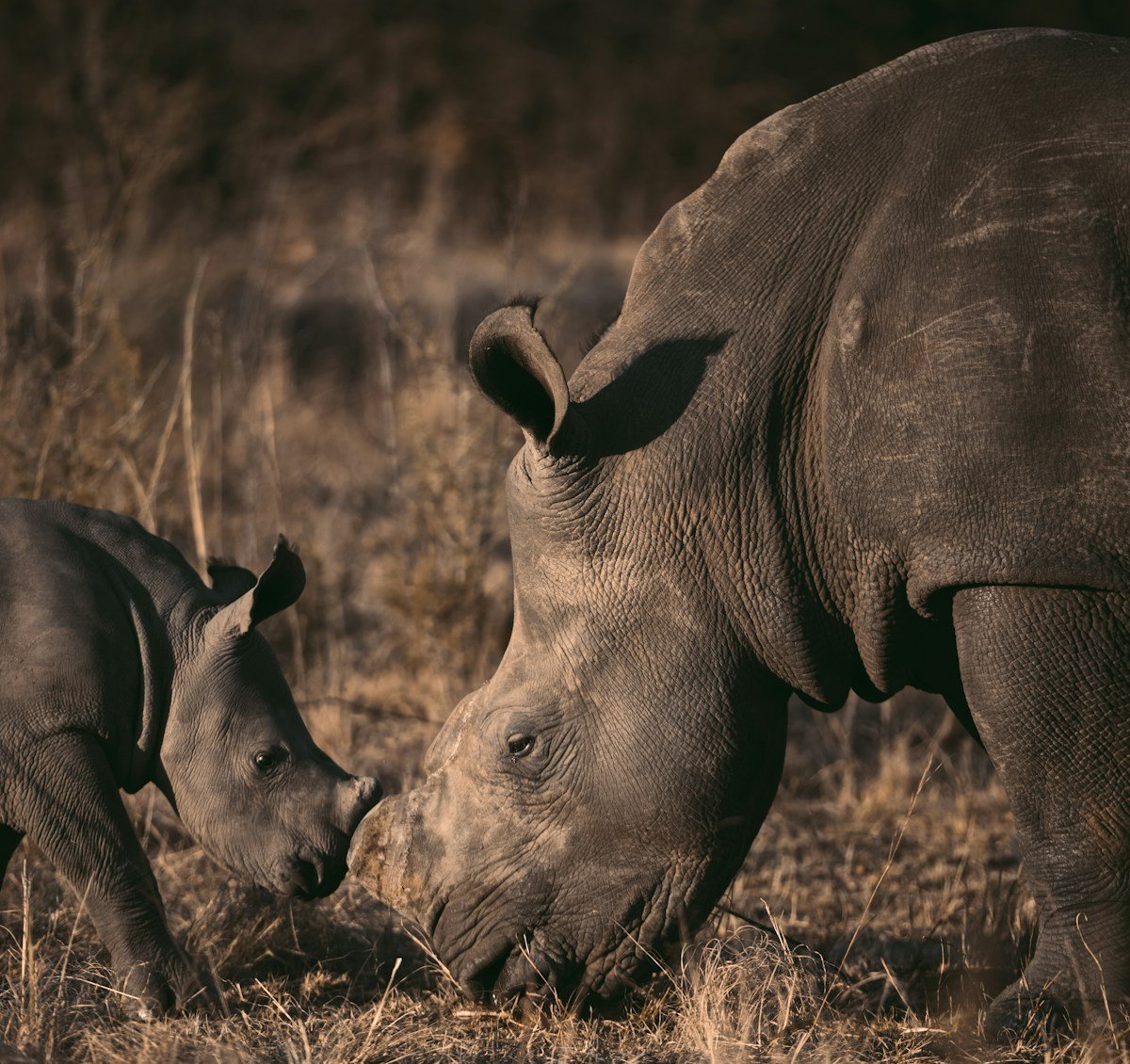
Of all the wildlife experiences in Zimbabwe, tracking rhino on foot through the granite kopjes of Matobo National Park is the one that tends to stop people in their tracks - sometimes literally. White rhino can weigh over 2,000 kg. When one turns to face you from twenty metres away in open scrubland, the scale lands differently than from a vehicle window.
Matobo, 35 kilometres south of Bulawayo, is a UNESCO World Heritage Site holding one of Africa’s highest-density white rhino populations alongside significant black rhino. Its Intensive Protection Zone (IPZ) - a fenced and ranger-patrolled area within the broader 424 km² park - allows guided foot tracking with success rates consistently above 85%. No other experience in Zimbabwe puts you this close to a wild rhino on foot.
White Rhino vs Black Rhino: What to Expect
White Rhino
The majority of Matobo’s rhino population is white rhino (Ceratotherium simum), also known as square-lipped rhino. White rhino are grazers - they feed on short grass and tend to move in loose family groups of two to five animals. Their temperament is generally calmer than black rhino, which makes foot tracking safer and allows for extended observation.
Matobo’s white rhino population has grown steadily under the IPZ management programme, run in partnership between Zimbabwe Parks and Wildlife Management Authority (ZPWMA) and conservation NGOs. Rangers track specific family groups by name and know their territory well. On most mornings, overnight radio reports from night rangers allow the guide to start the day with a known position for the nearest animals.
What the walk looks like: You are dropped near the last known rhino location and proceed on foot through grassland and around kopjes. The approach to the animals is slow and deliberate - wind direction matters, movement is kept minimal. The final approach typically brings you within 20 to 40 metres of the animals. You observe for 15 to 30 minutes before withdrawing quietly.
Black Rhino
Black rhino (Diceros bicornis) are present in Matobo but significantly fewer in number. They are browsers rather than grazers, feeding on shrubs and leaves in the rocky scrub - habitat that suits the Matobo kopje landscape but makes them harder to locate.
Black rhino are notoriously more aggressive than white rhino; foot approach protocols are more cautious and observing time is shorter. Your ranger will be aware of current black rhino locations, but sightings are not guaranteed on any given day. If you specifically want black rhino, mention it when booking - some operators and rangers can direct the walk toward areas where black rhino have been active recently.
Guided Tracking vs Self-Drive: The Honest Comparison
Visitors sometimes ask whether they can see rhino on a self-drive through the park. The short answer is: very unlikely. The Intensive Protection Zone - where the rhino population is concentrated and managed - is not accessible to unguided vehicles. The public area of the park does hold some wildlife (zebra, giraffe, baboon, klipspringer), but rhino sightings there are incidental rather than reliable.
Guided tracking on foot is not optional for safety reasons - ZPWMA regulations require a licensed ranger carrying a high-calibre rifle for all rhino approach walks. This is for the protection of both visitors and animals. Self-drive is fine for exploring the rock art sites (Nswatugi Cave, White Rhino Shelter), World’s View, and Chapman’s Baobab - but for rhino, book a guided walk.
Operators and Prices (2026 Estimates)
ZPWMA Walks from Main Camp (Budget)
Zimbabwe National Parks runs guided rhino tracking walks directly from Matobo Main Camp. This is the most affordable route.
- Walk fee: approximately USD 25–40 per person
- Park entry: approximately USD 15–20 per person per day
- Group size: up to 10–12 people
- How to book: at the Matobo gate on arrival, or via the Bulawayo Parks Authority office on Leopold Takawira Avenue (call ahead to confirm availability)
Groups can be large, and start times are fixed rather than flexible. The ranger quality is generally good - ZPWMA staff know the IPZ territory well - but the experience is less tailored than a lodge-run walk.
Camp Amalinda (Mid to Luxury)
Amalinda is the most architecturally distinctive property in the Matobo area. Suites are built into and around the natural granite boulders - rooms sit on top of kopjes, with boulders forming the walls and ceilings. Rhino tracking is included in the all-inclusive lodge rate.
- All-inclusive rate: approximately USD 450–650 per person per night as of 2026
- Day tracking for non-guests: not always available - enquire directly; priority is given to lodge guests
- What’s included: full-board meals, guided activities including rhino tracking, park fees, transfers within the park
Amalinda suits travellers for whom the accommodation is as much part of the experience as the wildlife. The setting - meals served on granite slabs, stargazing from boulder terraces - is unlike anything else in this price range in Zimbabwe.
Matobo Hills Lodge (Mid-Range)
Matobo Hills Lodge is the most frequently recommended property for a combination of access, service, and value. It is located inside (or immediately adjacent to) the park and runs rhino tracking as both a lodge activity and a day experience for non-guests.
- Day tracking for non-guests: approximately USD 90–120 per person including park entry, armed ranger, and vehicle transfer to the tracking area
- Accommodation: approximately USD 350–500 per person per night, all-inclusive
The lodge uses private-vehicle transfers to drop-off points rather than requiring guests to walk from Main Camp, which shortens the approach time and gives the ranger more flexibility on positioning.
Sable Lodge Matobo (Budget-Mid)
Sable Lodge operates a smaller bush camp adjacent to the national park. It is a quieter, more basic option than Amalinda or Matobo Hills Lodge - fewer frills, but solid value and genuine bush atmosphere.
- Day tracking for non-guests: approximately USD 80–100 per person including park entry
- Accommodation: approximately USD 200–280 per person per night, all-inclusive
World Heritage Site Context
Matobo was inscribed as a UNESCO World Heritage Site in 2003 for both its natural and cultural values - a dual recognition given to relatively few African parks.
San Rock Art
More than 3,000 documented San Bushman paintings are spread across the park’s cave overhangs and kopje faces, some dating back 13,000 years. The main accessible sites are Nswatugi Cave (large panel with giraffe, eland, and human figures), White Rhino Shelter (featuring one of the most precisely observed rhino images in the Matobo corpus), and Inanke Cave. A Parks guide at each site provides context on San cosmology and the meaning of individual images.
Rozvi Citadels and Ndebele History
Beyond the San paintings, Matobo holds the ruins of several Rozvi-era stone enclosures - predecessors to the building tradition that produced Great Zimbabwe. The Rozvi state flourished in this region from roughly the 17th to early 19th century before being displaced by Mzilikazi’s Ndebele kingdom, which made the Matobo Hills - called Malindidzimu, “dwelling place of spirits” - a sacred burial ground. World’s View, where Cecil Rhodes is interred, sits within this Ndebele sacred landscape; the tension between colonial history and indigenous heritage is palpable at the site.
Where to Stay Near Matobo Hills
Budget (USD 20–60 per person per night)
Bulawayo lodges and guesthouses are the practical base for budget travellers. The park is 35–40 minutes from the city by car, and day-trip operators run shuttles from central Bulawayo. Bulawayo guesthouses like Hayotas, Shoshangaan Guest House, and Accommodation Plus offer beds from approximately USD 25–50 per person per night with breakfast.
ZPWMA camping at Matobo Main Camp offers basic sites (ablutions, braai stands, no electricity) at approximately USD 10–15 per person per night. Book via the ZPWMA Harare office or at the gate. This puts you inside the park at sunrise - a significant advantage for tracking and game viewing.
Mid-Range (USD 120–280 per person per night)
Sable Lodge Matobo (see above) is the best mid-range option with in-park access. Rocky Outcrop Chalets, near the park boundary, offers self-catering accommodation at approximately USD 80–130 per person per night - suitable for groups with their own vehicle and a plan to book ZPWMA guided walks separately.
Lodge / Luxury (USD 300–650 per person per night)
Camp Amalinda and Matobo Hills Lodge are the two main lodge options at this level. Both are all-inclusive with guiding and park fees included. For a standalone rhino experience combined with a special lodging night, Amalinda is the stronger choice. For a family or group trip where flexibility matters, Matobo Hills Lodge offers more schedule options. For a broader selection of accommodation near the Matobo Hills area, search hotels on Booking.com to compare Bulawayo-based and park-adjacent options across all price tiers.
Getting There from Bulawayo
By car: The most practical option. From Bulawayo city centre, take the Matobo Road (Robert Mugabe Way heading south, turning onto the Matobo/Fort Rixon Road). The main park gate at Maleme Dam is 35 kilometres from the city - approximately 40 to 50 minutes on a tar road that requires no 4WD. A standard vehicle is sufficient for the main tourist areas including Nswatugi Cave, World’s View, and Main Camp.
Car hire in Bulawayo: Several agencies operate from Bulawayo including Europcar (at the Bulawayo Rainbow Hotel) and local operators. Rates start from approximately USD 60–80 per day for a compact vehicle as of 2026. For the southern areas of the park (Chapman’s Baobab, Silozwane Cave), a high-clearance vehicle is recommended.
By shuttle or day-trip operator: Multiple Bulawayo-based operators run full-day trips to Matobo combining rhino tracking, rock art, and World’s View. Cost is typically USD 120–180 per person including guide, vehicle, park entry, and lunch. Operators include Wild Horizons Bulawayo, UTC Zimbabwe, and Thebe River Safaris (who also operate from Victoria Falls). Book through your Bulawayo guesthouse or directly.
No public bus: There is no scheduled kombi or bus service into Matobo National Park. Hitchhiking to the gate is possible but unreliable for getting back to Bulawayo in time. For independent travellers without a vehicle, a day-trip package is the most practical solution.
Distance from other hubs: Harare to Bulawayo is approximately 440 kilometres (4.5–5 hours by road or 1 hour by Air Zimbabwe or Fastjet). Victoria Falls to Bulawayo is approximately 440 kilometres on the Bulawayo-Victoria Falls highway (4.5–5 hours). Both cities have daily intercity buses.
The rhino tracking walk in Matobo is not a standard game drive with a wildlife sighting attached. It is a physical encounter at close range, on foot, in terrain that has been managed specifically for that purpose - and the results are consistently among the most affecting wildlife experiences in southern Africa. Pair it with a morning at Nswatugi Cave and a late afternoon at World’s View and you have a day that covers 13,000 years of Zimbabwean history. See the Matobo Hills safari guide for a full overview of the park including all activities, or browse the Zimbabwe wildlife guide for park comparisons across the country.