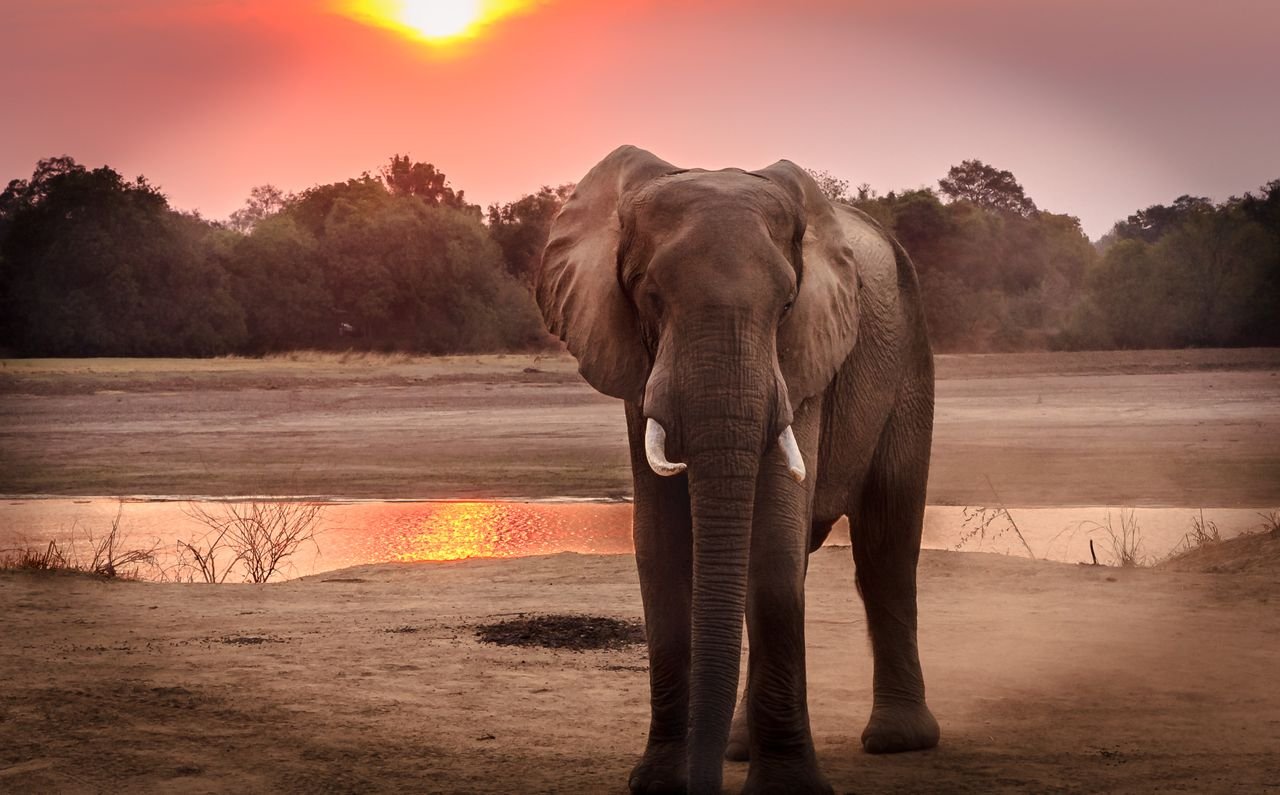
Matusadona National Park runs along the southern shore of Lake Kariba, where the drowned-forest shoreline meets mopane woodland and the Escarpment rises behind. It is one of the quietest major parks in Zimbabwe: no tarred road reaches it, so almost everyone arrives across the water. That remoteness is the appeal. Elephant and buffalo graze the lake’s grass shoreline, lion hunt the hills behind it, and a boat tender gets you closer to hippo and crocodile than most vehicle-based safaris ever will.
The park is also in a rare period of change. In November 2019 African Parks signed a 20-year agreement with ZimParks to manage it, and in June 2026 17 black rhino were returned after more than a decade with none. Few Zimbabwean parks have this much new investment behind them.
Getting There
By boat from Kariba town. This is the standard route. The crossing is roughly 50 to 55 km and takes 1.5 to 2 hours depending on the vessel and your destination, with lodges such as Bumi Hills 14 km by water from the park headquarters at Tashinga. Most camps arrange the transfer, collecting you from Kariba harbour. If you drive to Kariba yourself (about 365 km, 4 to 5 hours from Harare, see our car rental guide), secure parking is available at the harbour area for approximately USD 5 per day as of 2026; ask your lodge to confirm where.
By ferry. A privately operated vehicle ferry run by Davy McMaster already crosses from Kariba to Tashinga, taking about three hours; it is booked and paid for directly with the operator, not through African Parks. African Parks has also procured its own vehicle and passenger ferry, but its information pack (undated) says only that it is launching soon with dates to be confirmed, and that ferry links and a lakeshore road are unlikely before 2027. We could not get a timetable, so do not plan around the African Parks ferry until your lodge or African Parks confirms one. Do not confuse either with the long-distance Kariba to Mlibizi ferry, which passes the park but does not stop there.
By road. Access is 4x4 only, from the Karoi to Binga road. Tracks are rough, slow and cut by washouts; one overland trip report from 2022 recorded about 30 km taking three hours. Carry two spare wheels, recovery gear and fuel, and tell someone your plan. The road is not an option in the wet season.
By air. A light-aircraft strip of around 700 metres serves Tashinga; permission to land must be obtained in advance. Camps usually arrange charter flights from Kariba, Harare or Mana Pools as part of a package.
When to Go and the Wet-Season Closure
The official wet season runs November to April (about 650 mm of rain), and the park effectively shuts: African Parks publishes no fixed closure dates, so confirm with your lodge. Rain turns the tracks to mud, rivers rise, and camps close or cut back. The window that works is May to October. July to October is the peak: the shoreline grass is the last green food on the lake edge, so elephant and buffalo concentrate in front of the camps, and predators follow. Tiger fishing peaks from September to November, which overlaps with the dry-season end; see our Kariba fishing guide. Days are warm and nights cool in June and July; October is hot.
What to Do
- Boat safaris: the lake edge is the star. Tender boats slip through the drowned timber for elephant, hippo, crocodile and fish eagle. Our Lake Kariba wildlife guide covers what you will see in more detail.
- Walking safaris: guided walks with armed rangers from the lodges are the best way to read tracks, spoor and bird calls.
- Game drives: vehicle drives run from camps with road access inside the park; routes are limited, so go with a lodge guide.
- Fishing: tiger fish are the headline; Matusadona’s shoreline is among the most productive stretches of Kariba.
- Houseboat add-on: many visitors combine a Lake Kariba houseboat with a night or two on land.
For operator-led day trips and boat excursions, browse Lake Kariba tours.
Where to Stay
Camps here are remote and mostly all-inclusive, with the best of them at roughly USD 400 to 750 per person per night as of 2026. We list properties by type and have not tied any to a specific price you can book online, so confirm current rates with the operator. For options in Kariba town before or after the park, see where to stay in Kariba or search Kariba hotels.
- Bumi Hills Safari Lodge: a clifftop lodge above the lake, more resort than bush camp, with boat safaris and walking. It sits close to the park boundary and is the most comfortable base for first-timers.
- Changa Safari Camp: raised tented chalets on a private lakeside concession, known for guiding, birding and fishing.
- Rhino Safari Camp: on Rhino Island in the park, with game drives, walks and elephant crossing the shallows at low water.
- Musango Safari Camp: on its own island, led by a former park warden, with a strong reputation for guiding and tiger fishing.
- Spurwing Island: the most accessible choice, a family-oriented resort about 20 minutes by speedboat from Kariba town on a spit off the park’s mainland, suited to a first taste of the area and to the tightest budgets.
- Tashinga: the park’s own camp at the headquarters, with basic self-catering accommodation and camping for self-drivers on the 4x4 route. Book through ZimParks or African Parks.
Some sources place Bumi Hills, Musango and Spurwing just outside the park boundary and others inside, so check a current park map before assuming what your entrance fee covers. Park fees follow the ZimParks 2026 tariff.
Practical Notes
- Malaria: Kariba is a high-risk zone year-round. See our vaccinations and malaria guide.
- Money and supplies: carry cash and pre-arranged payment for fees; there is no shopping in the park.
- Rhino: the returned black rhino are being protected carefully in a secure area. Treat any sighting as luck, not a promise, and do not pay a premium for a guaranteed rhino.
- Connection: mobile signal is patchy to nonexistent beyond Kariba town.
- Back at base: for the wider lake, boat transport and town services, start with the Kariba city guide.